AI Chatbots
How to Measure RAG Accuracy Before You Launch
RAG accuracy is two scores, not one. See how to build a gold question set, measure both halves, and set release gates that hold.
A voice AI agent answers support calls from your own documents. See the stack, the latency budget and a safe rollout plan.
 By Yatin Chaudhary
10 min read
By Yatin Chaudhary
10 min read
A voice AI agent picks up the phone, listens to the caller, and answers in a natural voice. In fact, it skips the old menu tree. Instead, it hears the question, searches your own documents, and speaks a grounded reply.
Phone calls still carry most of the support load in India. So voice is where the queue hurts, and where automation pays back fastest. This guide walks through the stack, the latency budget, the guardrails and a rollout plan your leadership team will accept.
Think of four jobs running in a loop. First, it turns speech into text. Second, it works out what the caller wants. Third, it finds the answer in your policies, orders or tickets. Finally, it speaks that answer back.
Of course, an IVR menu cannot do this. It only maps key presses to branches. A voice AI agent handles free speech, so a caller can say “my order from Tuesday has not moved” and still get a useful reply.
The agent also acts. For example, it can check an order, raise a ticket, send a link on WhatsApp, or pass the call to a person. Because of that, the word agent fits better than the word bot.
Chat deflection helps, yet the phone still drives cost. Every minute on hold burns money and goodwill. Meanwhile, the same twenty questions repeat all day.
Three gains show up early:
Chat still matters, of course. If you have not started there, our guide on how to reduce support tickets with an AI chatbot is the cheaper first step.
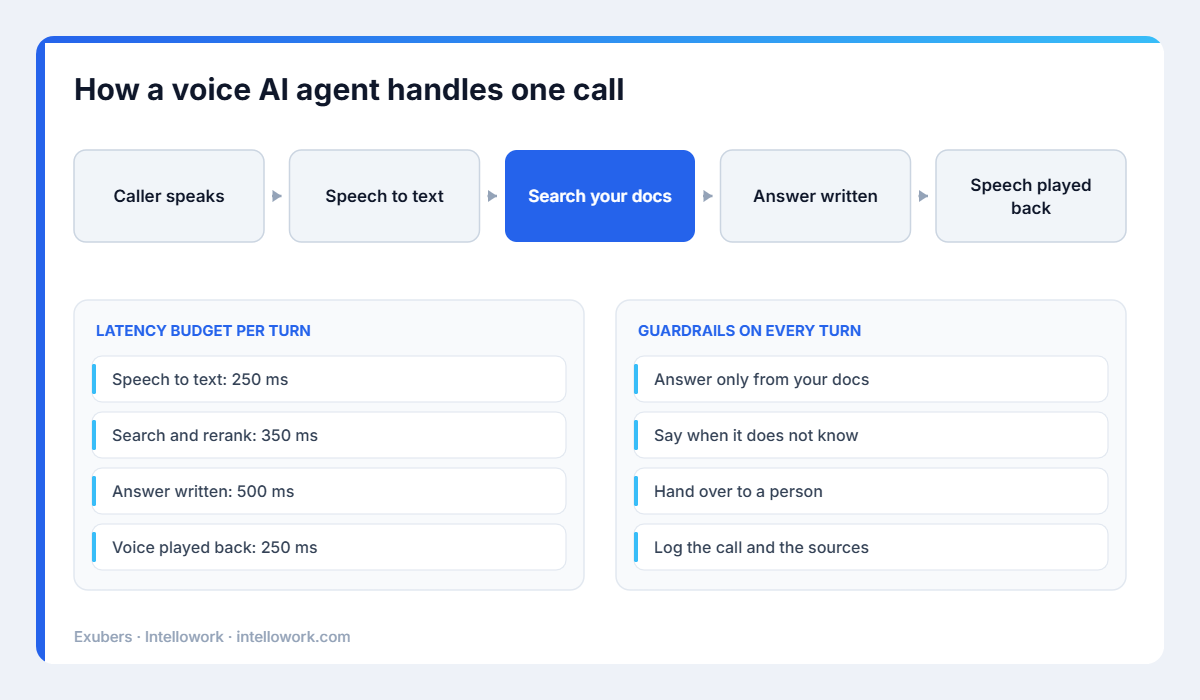
In short, five parts sit behind every turn. Speech to text converts audio into words. A retrieval layer searches your documents. A language model writes a short reply. Text to speech voices it. An orchestrator holds the thread together and manages the phone line.
Still, each part is a choice, not a given. Speech models differ a lot on Indian accents, so test them on your own recordings. Voices differ too, and callers judge the voice within two seconds.
Above all, the retrieval layer decides whether answers are true. It pulls the refund policy, the plan sheet or the order record. Then the model writes only from what it received.
People forgive a wrong word. They do not forgive a pause. Aim for a reply that starts inside 1.2 seconds, because longer gaps feel broken on a phone line.
| Step | Target | What blows it up |
|---|---|---|
| Speech to text | 200 to 300 ms | Waiting for the full sentence instead of streaming |
| Search and rerank | 250 to 400 ms | Large chunks, cold indexes, far region |
| Answer written | 400 to 600 ms | Long prompts, big models, no streaming |
| Voice played back | 200 to 300 ms | Rendering the whole reply before playback |
Two tricks buy most of the time back. Stream every stage, so playback starts on the first clause. Also keep the model in the same cloud region as the caller, which for India usually means Mumbai.
Barge-in comes first. A caller must be able to interrupt, and the agent must stop mid word. Without that, the call feels like a recording.
Silence handling comes next. After two seconds of quiet, the agent should prompt once, warmly. After six, it should offer a person.
Numbers and names need care as well. Order IDs, PIN codes and amounts should get read back for confirmation. Similarly, spellings of names deserve a quick check before the agent files a ticket.
| Situation | Better channel | Why |
|---|---|---|
| Order status, balance, slot booking | Voice | One short answer, hands busy, caller in a hurry |
| Long policy explanation | Chat | People want to read and keep the text |
| Document upload or a form | Chat | Links and files do not travel by voice |
| Angry escalation | Person | Tone matters more than the answer |
| Rural callers with weak data | Voice | A phone call works where an app does not |
A model that speaks from memory will invent things. On a phone call nobody sees a source link, so an invented refund window sounds exactly like a real one. That is why grounding matters more in voice than anywhere else.
Three rules keep it honest. The agent answers only from retrieved text. It says plainly when it does not know. Finally, it logs the documents behind every answer, so you can audit any call later.
We wrote a longer piece on the same problem in text channels. Read it if you want the full method to stop AI chatbot hallucinations.
Hinglish. Callers switch between Hindi and English inside one sentence. So your speech model and your search layer both need to cope, not just one of them.
Telephony. Mobile audio is narrow band and noisy. Test on real recordings from your own numbers, not on studio samples. Otherwise the demo shines and the launch stumbles.
DPDP. Calls carry personal data by nature. Keep recordings in India, mask account numbers in transcripts, and set a deletion window. Our note on a permission aware chatbot under DPDP covers the access side of this.
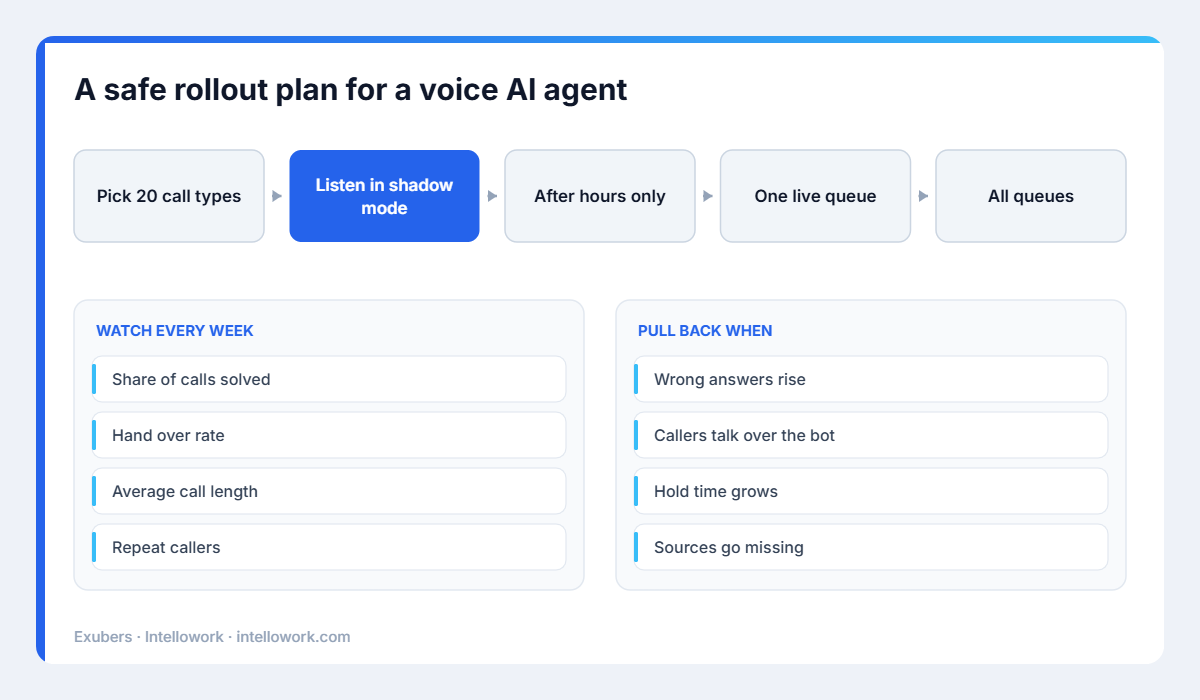
Start narrow. Pick the twenty call types that repeat most, and write the ideal answer for each. Then run the agent in shadow mode, where it listens and drafts while a person still speaks.
After that, go live after hours only. Night callers are usually happy to get any answer at all. Once the numbers hold, open one daytime queue, and finally the rest.
Keep a way back at every stage. A single toggle should send all calls to people again. Because that toggle exists, your team will experiment instead of freezing.
| Line item | Rough range per minute | Notes |
|---|---|---|
| Speech to text | ₹0.40 to ₹1.20 | Streaming models cost more, yet feel far better |
| Language model | ₹0.30 to ₹1.50 | Short prompts and small models keep this low |
| Text to speech | ₹0.50 to ₹2.00 | Premium Indian voices sit at the top of the range |
| Telephony | ₹0.30 to ₹0.80 | Depends on your provider and call volume |
Add it up and a contained call usually lands between ₹2 and ₹5. A person handling the same call costs far more. So the payback question is rarely about price, but about how many calls the agent can finish alone.
Not every call type deserves the same treatment. Sort them by volume and by risk, then start where volume is high and risk is low.
| Call type | Volume | Risk if wrong | Start here? |
|---|---|---|---|
| Order or shipment status | High | Low | Yes, week one |
| Store timings, branch address | High | Low | Yes, week one |
| Plan and pricing questions | Medium | Medium | Yes, once sources are clean |
| Refund and cancellation rules | Medium | High | Later, with tight grounding |
| Complaints and disputes | Low | High | No, route to a person |
Meanwhile, write the ideal answer for each type before you build anything. Because that document becomes your test set, it saves weeks later. Our post on how to test an AI chatbot before launch explains how to turn those answers into gates.
Answers from documents solve half the calls. The other half need live data, such as an order record or a due date. So the agent needs read access to two or three systems, and nothing more.
Keep the tool list short at first. One lookup for orders, one for tickets, one for account status. Each tool should return a small, clean object rather than a full screen of fields.
Write actions deserve extra care. Raising a ticket is safe, since a person reviews it later. Changing an address or cancelling an order is not, so keep those behind a confirmation or behind a person.
Where does the content itself come from? Usually your existing drives and wikis. An AI chatbot over SharePoint, Google Drive and Confluence uses the same index, so both channels stay in step.
Callers rarely complain about a machine. They complain about repeating themselves to the person who comes next. Therefore the hand over deserves as much design as the answer.
In short, pass three things across: the transcript, the caller identity, and what the agent already tried. Then the person opens the call with context instead of a blank screen.
Similarly, trigger the hand over early on emotion. If a caller raises their voice, repeats a question twice, or asks for a person, stop and transfer. Above all, never make someone ask three times.
So run through this list with your IT team. It takes an hour, and it prevents the awkward audit six months later.
None of this slows the build much. Still, it changes how your legal team feels about the launch.
Intellowork already indexes your policies, SOPs, tickets and product sheets. The voice layer sits on top of that same index, so the phone gives the same answer as the chat window.
Moreover, permissions travel with the caller, and every answer carries its sources in the log. Deployments run inside your own cloud account in Mumbai, which keeps recordings and transcripts in India.
If you want to see a voice AI agent trained on your own documents, book a walkthrough with our team. We usually start with one queue and a two week pilot.
Usually, a focused pilot takes two to four weeks. Most of that time goes into content clean up and test calls, not into the model itself.
Yes, and you should tell them in the first line. Trust rises when you are open about it, and Indian callers rarely object once answers are quick.
It should say so and offer a person. A clean hand over, with the transcript attached, beats a confident guess every time.
Yes, if the speech and search layers are multilingual from the start. Test Hinglish specifically, because models that pass on clean Hindi often stumble on mixed sentences.
No. It absorbs the repeat questions, while your team keeps the cases that need judgement. Most teams reassign people rather than reduce them.
Finally, track containment, hand over rate, average handle time and repeat calls within seven days. Also listen to twenty calls each week yourself, because numbers hide tone.
The short version: a voice AI agent works when it answers fast, speaks only from your documents, and steps aside politely. Get those three right, and the phone stops being your most expensive channel.

Yatin Chaudhary writes on enterprise search, AI retrieval and platform engineering at Exubers Technologies, where the team builds search, AI, cloud and DevOps systems for enterprises across India and the GCC.
RAG accuracy is two scores, not one. See how to build a gold question set, measure both halves, and set release gates that hold.
A multilingual AI chatbot answers a Hindi question from English documents. Here is the architecture, the testing method and a…
A repeatable way to test an AI chatbot before launch: build a golden question set, score retrieval and grounding separately, and…
Tell us what you are trying to ship. We will tell you what it actually takes — scope, sequence and the risks worth knowing about before you commit budget.