AI Chatbots
How to Measure RAG Accuracy Before You Launch
RAG accuracy is two scores, not one. See how to build a gold question set, measure both halves, and set release gates that hold.
Most support chatbots close conversations instead of solving them. Here is the containment logic, the honest deflection maths and the 60-day plan that actually shrinks the queue.
 By Yatin Chaudhary
11 min read
Updated 4 Sep 2026
By Yatin Chaudhary
11 min read
Updated 4 Sep 2026
Support teams rarely ask for a chatbot. They ask for a quieter queue. If you want to reduce support tickets without annoying your customers, the tool matters far less than the way you set it up. This guide walks through the approach we use with clients, and the numbers you should insist on before anyone calls the project a success.
Most teams start in the same place. Volume grows faster than headcount. Agents answer the same ten questions all day. So someone buys a chatbot, switches it on, and waits for the queue to shrink. Six weeks later the queue looks the same, and the customer satisfaction score looks worse.
That outcome is common, but it is not inevitable. The teams that genuinely reduce support tickets do three things differently. They ground every answer in their own documentation. They gate answers on confidence. Above all, they measure resolution rather than closure.
There are only three honest ways to shrink a support queue. You can stop the question from arising. You can let the customer answer it alone. Or you can answer it faster with fewer people. An assistant helps with the second, and it helps a little with the first.
Notice what is missing from that list. Closing a conversation is not on it. A bot that says “sorry, I cannot help with that” and ends the chat has closed a conversation. It has not removed a ticket. The customer simply arrives again by email an hour later, now irritated.
So the goal is narrow. You want fewer questions reaching a human, while the customer still gets a correct answer the first time. Everything below serves that one sentence.
We audit a lot of assistants that were switched on with enthusiasm and quietly ignored six months later. The failure patterns repeat.
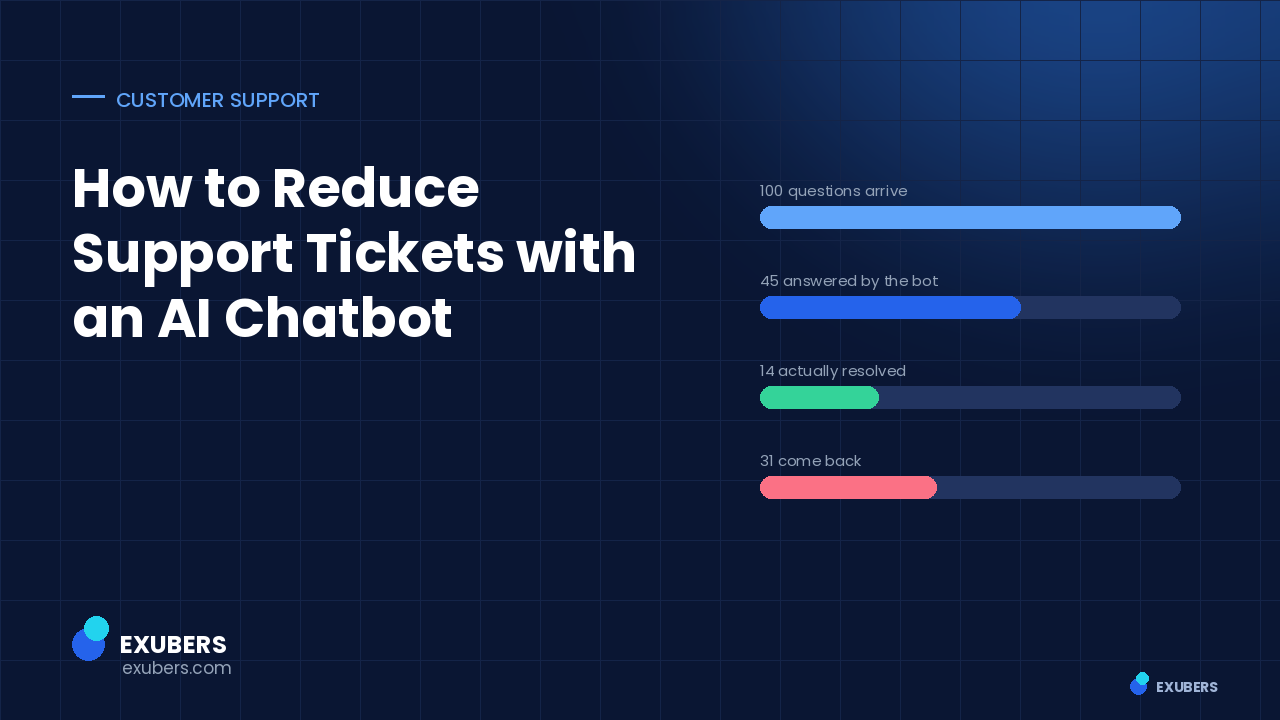
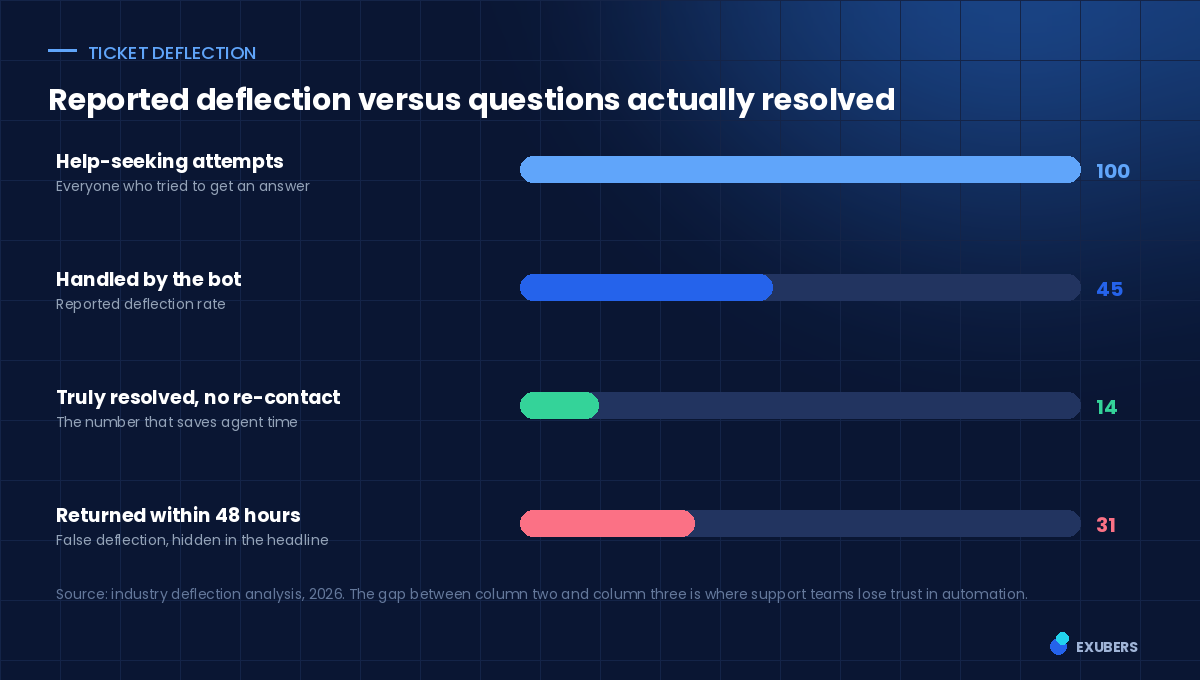
Industry analysis of deflection data suggests a wide gap between the two. One 2026 review found that assistants deflect more than 45 percent of queries, while only around 14 percent reach full self-service resolution. The rest come back through another channel. Your dashboard shows a win. Your agents feel none of it.
Many deployments are trained on marketing pages, because those are tidy and public. Meanwhile the real answers sit in an internal wiki, a policy document and three long email threads. As a result the assistant sounds confident and stays useless.
“Where is my order” is not a knowledge question. It is a lookup. If your assistant cannot reach the order system, it can only describe your shipping policy in general terms. That answer never satisfies anyone, so the ticket arrives anyway.
Finally, plenty of assistants trap people, which is the quickest way to lose the goodwill you need to reduce support tickets at all.
There is usually no obvious route to a human, or the route loses the conversation on the way. Customers then learn to skip the widget entirely, and your queue never changes.
A support assistant should behave like a careful new hire. It reads the documentation, answers when it is sure, and asks for help when it is not. That behaviour is a design choice, not a model capability.
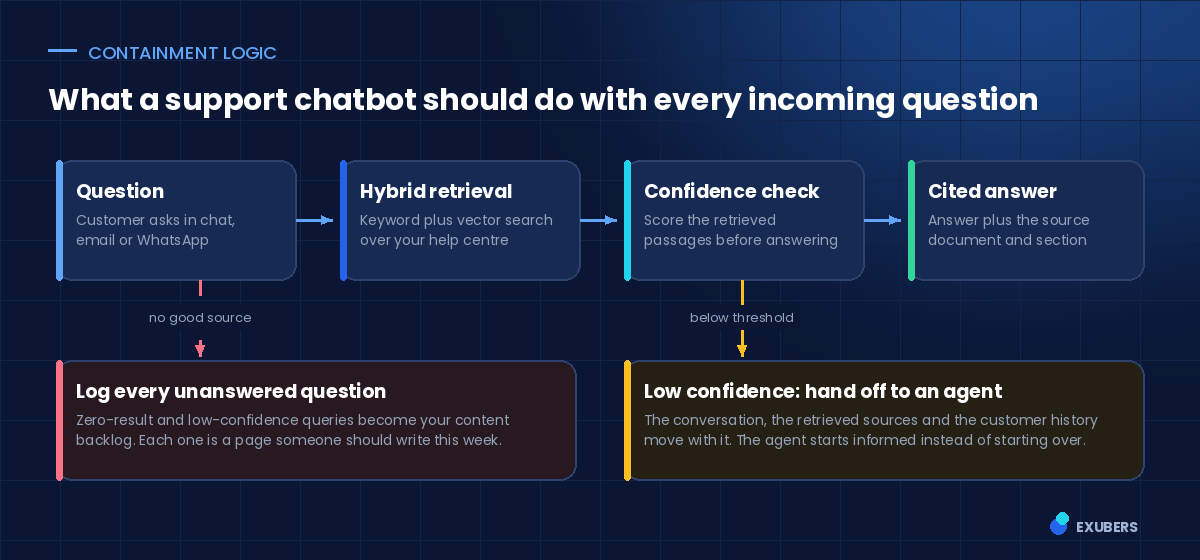
Every answer should start with a search across your own content. Hybrid search works best here, because it combines exact keyword matching with meaning-based recall. Customers who know your product name need precision. Customers who describe a problem in their own words need semantic recall. You need both, which is exactly what our enterprise search engineering practice builds.
Show the document, the section and the update date beside every reply. Two things happen. Customers trust the answer, because they can check it. Agents trust the assistant, because they can see where a wrong answer came from and fix the page behind it.
Score the retrieved passages before writing anything. If the score sits below your threshold, do not improvise. Say that you are not sure, and offer a person. A confident wrong answer costs far more than an honest handoff, because it creates a second ticket and a complaint.
When the assistant escalates, the agent should receive the transcript, the retrieved sources and the customer record together. Otherwise the customer repeats themselves, and the handoff feels like a punishment for using the widget.
This is the part teams skip, and it is the part that compounds. Every low-confidence query is a content gap. Review that list weekly. Write the missing page. Next month those questions resolve on their own, and you reduce support tickets again without touching the model.
You cannot manage this with one number. Reported deflection is easy to hit and easy to fake. True deflection is harder, and it is the only figure worth putting in a board pack.
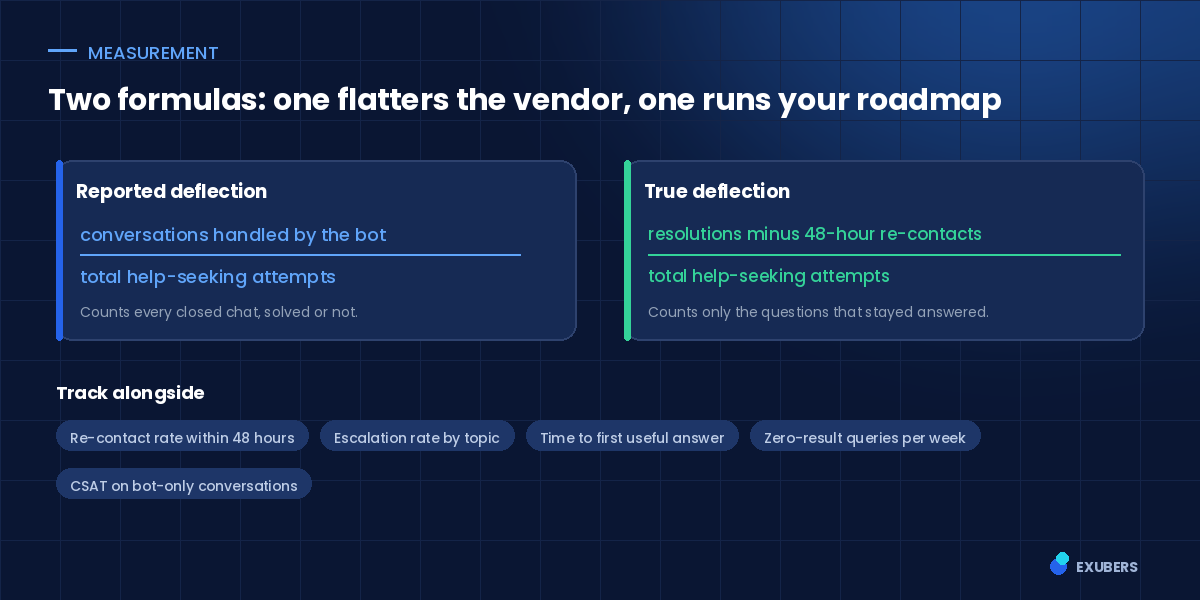
Divide the conversations the assistant handled by every help-seeking attempt. This counts each closed chat, whether or not it solved anything. Vendors quote it because it flatters them. Track it, but never celebrate it.
Take the same denominator. In the numerator, subtract every customer who came back through any channel within 48 hours. What remains is the share of questions that genuinely stayed answered. In our experience this figure starts low, and that is fine. It is a baseline, not a verdict.
Deflection also varies enormously by question type. Password resets and order status deflect well. Billing disputes and complex troubleshooting do not. So set targets per topic rather than one number for the whole queue.
You do not need a year. You need a narrow scope and an honest baseline. Here is the sequence we run.
Export the last quarter of tickets. Cluster them. Take the ten highest-volume questions that have a single correct answer. Ignore everything emotional or account-specific for now. Then measure how many tickets those ten topics generate today, because that is your baseline.
Point the assistant at the sources that actually contain the answers. Rewrite any page that a new colleague could not follow. This step feels like editing rather than engineering, and it produces most of the eventual gain.
Let the assistant answer silently beside your agents. Nobody sees its replies except the team. Agents rate each one. You will find retrieval gaps here at a tenth of the cost of finding them in production.
Launch on a single channel, with an obvious route to a human on every reply. Watch re-contact rate daily for the first two weeks. If it climbs, raise the confidence threshold rather than rewriting prompts.
By month three the pattern is usually clear, and you can say plainly whether the assistant helped you reduce support tickets or simply moved them around. The ten chosen topics deflect well. Re-contact rate is stable. The weekly gap list has become a normal part of the content team’s routine, and the assistant handles a growing share of the queue as those pages get written.
Agents notice something else too. The tickets that do arrive are more interesting. Nobody spends the morning pasting the same refund policy for the fortieth time. That change in the work itself is often the reason support leaders stay committed to the project.
Platforms built for this pattern make it easier to start. Intellowork takes exactly this approach: it turns your existing documentation into cited answers across a web widget, WhatsApp, Slack and an API, using hybrid keyword and vector retrieval with confidence-aware replies and a clean handoff to a live agent. Because every answer names its source, the weekly gap review is straightforward rather than archaeological.
If your content is scattered across systems, that groundwork comes first. Our AI and NLP engineering team handles the retrieval layer, the evaluation harness and the integrations that let an assistant see an order rather than describe a policy.
Not every topic is worth automating. The fastest way to reduce support tickets is to sort your queue by two things: how often a question arrives, and how stable the answer is. High volume with a stable answer is where you start.
| Question type | Answer stability | Automate first? |
|---|---|---|
| Password and access resets | Very stable | Yes, day one |
| Order status and tracking | Stable, needs a lookup | Yes, once the system is connected |
| Policy questions such as refunds or warranty | Stable, changes a few times a year | Yes |
| Setup and how-to guidance | Moderately stable | Yes, after the pages are rewritten |
| Technical troubleshooting | Varies by case | Partly, with a fast route to a person |
| Billing disputes and complaints | Case by case | No, route straight to an agent |
The bottom two rows matter as much as the top. An assistant that tries to handle a complaint will make the situation worse. Send those to a person immediately, and let the assistant summarise the conversation so the agent starts with context.
Knowledge alone takes you part of the way. To reduce support tickets meaningfully, the assistant usually needs to look something up. Order status, subscription tier, delivery date, open ticket history. Each connection you add moves a whole category of question from “explain the policy” to “answer the question”.
This is normally an integration task rather than an AI task. So budget for it accordingly, and treat it as the second phase rather than an afterthought.
Teams often ask whether to build the assistant in house. Both routes can work. The difference is where your engineering time goes.
Building gives you full control over retrieval, prompts and data handling. However, the work that consumes the calendar is rarely the model. It is connectors, permissions, evaluation harnesses, channel plumbing and the admin tools your support leads need. Most teams underestimate that tail by several months.
Buying moves that tail to a vendor and leaves you the parts only you can do: choosing the topics, fixing the documentation and setting the confidence thresholds. For most support organisations that is the faster way to reduce support tickets, provided the platform cites its sources and lets you export your own data.
Either way, insist on three things. Every answer must name its source. Confidence must be visible and adjustable. And you must be able to read the full conversation log, because that log is where next quarter’s content plan comes from.
Take your monthly ticket volume for the ten chosen topics. Multiply by your fully loaded cost per ticket. Then apply a conservative true deflection figure, not the vendor’s headline. If the result does not comfortably cover platform and integration cost in a year, narrow the scope rather than stretching the assumptions.
It depends far more on your question mix than on the model. Simple, repetitive topics such as password resets or order status often deflect well above half. Billing disputes and complex troubleshooting deflect far less. A sensible first target is a measurable reduction on your ten highest-volume topics, not a single number across the whole queue.
Teams that scope tightly usually see movement on their chosen topics within eight to ten weeks. The limiting factor is rarely the technology. It is how quickly someone can rewrite the documentation those answers depend on.
They accept a correct answer delivered instantly. They reject a vague answer that blocks them from a person. So the escalation path matters as much as the answer quality, and it should be visible in every reply.
No. The assistant sits in front of your existing helpdesk and creates tickets when it escalates. Replacing a working ticketing system adds risk without adding deflection.
Optimising for reported deflection. Once raw deflection becomes the target, the incentive shifts to closing conversations rather than solving problems. Satisfaction falls, re-contacts rise, and the queue quietly refills. Measure true deflection from the first week instead.
Less than most teams assume. Ten well-written pages that answer your ten most common questions will outperform a thousand pages of scattered notes. Start there, then let the gap list tell you what to write next.
The teams that reduce support tickets successfully are rarely the ones with the largest budget. They are the ones who scoped narrowly, wrote better documentation, and refused to trust a headline deflection number. Pick your ten questions this week. Measure what they cost you today. Then decide whether an assistant grounded in your own documentation can answer them well enough to keep customers from writing in at all.
If you would like a second opinion on that list, talk to our team. We will look at your ticket data with you and tell you honestly which topics are worth automating first, and which ones need a person.
Read next: how to test an AI chatbot before launch, so the deflection numbers hold up after go-live.
Read next: Voice AI agent for customer support: a practical build guide.

Yatin Chaudhary writes on enterprise search, AI retrieval and platform engineering at Exubers Technologies, where the team builds search, AI, cloud and DevOps systems for enterprises across India and the GCC.
RAG accuracy is two scores, not one. See how to build a gold question set, measure both halves, and set release gates that hold.
A multilingual AI chatbot answers a Hindi question from English documents. Here is the architecture, the testing method and a…
A voice AI agent answers support calls from your own documents. See the stack, the latency budget and a safe rollout plan.
Tell us what you are trying to ship. We will tell you what it actually takes — scope, sequence and the risks worth knowing about before you commit budget.