AI Chatbots
How to Measure RAG Accuracy Before You Launch
RAG accuracy is two scores, not one. See how to build a gold question set, measure both halves, and set release gates that hold.
An assistant that can read every document in your company is an incident waiting for a question. Access control, residency and erasure belong in the retrieval layer, not in a policy…
 By Yatin Chaudhary
11 min read
Updated 2 Sep 2026
By Yatin Chaudhary
11 min read
Updated 2 Sep 2026
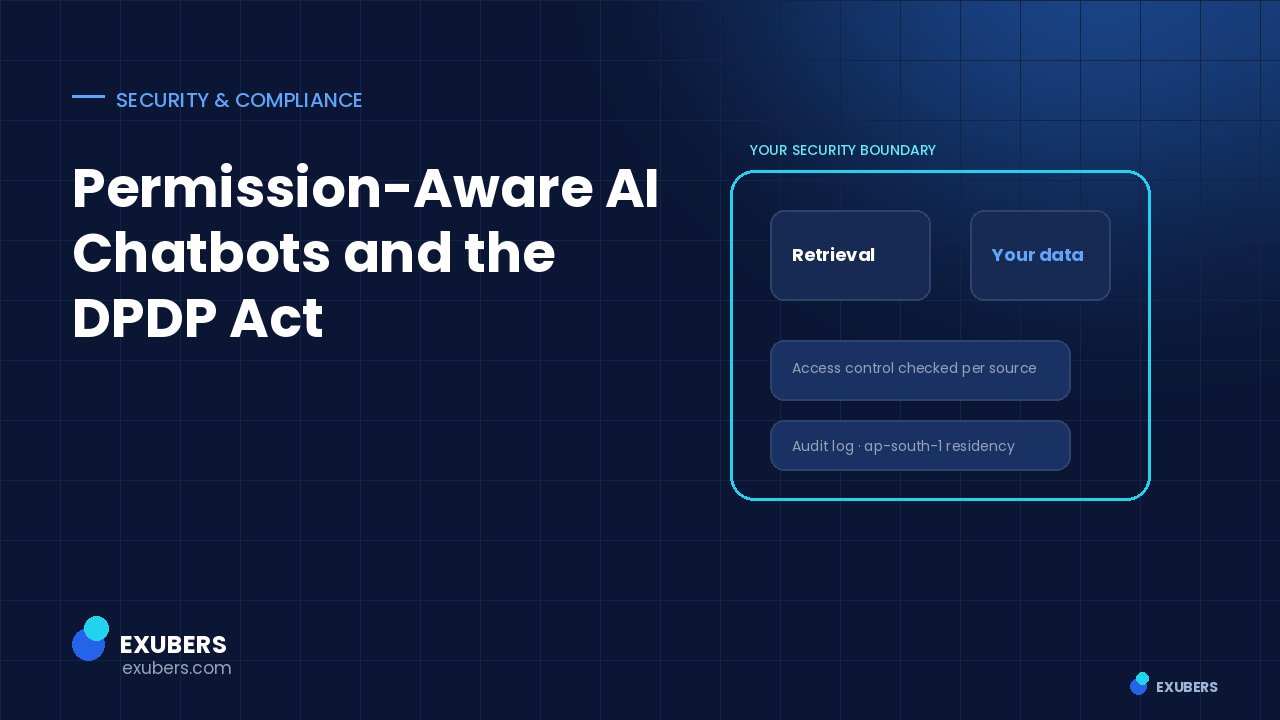
An assistant that can read every document in your company is a security incident waiting for a question. A permission-aware AI chatbot solves that by checking who is asking before it decides what to retrieve, and therefore what it is willing to say. For Indian enterprises, that control has moved from good practice to a compliance expectation.
This guide explains what permission-aware retrieval means in practice, the two ways to implement it, how data residency fits, and what the Digital Personal Data Protection Rules ask a deployment to support. It is written for architects and technology leaders rather than lawyers, and it is not legal advice.
The phrase sounds like a feature checkbox. It is really a design constraint that runs through the whole pipeline.
A permission-aware AI chatbot never retrieves a passage the current user could not open in the source system. Not “does not display it”. Does not retrieve it. The distinction matters, because a model that receives a restricted passage will happily summarise it, and the summary carries no access control at all.
So the check has to sit before generation. Once text reaches the model, the permission boundary is gone.
Traditional search returns links. If a user cannot open a link, the damage is limited to knowing that a document exists. An assistant returns content, rewritten in its own words, with no link for anyone to audit. As a result the failure mode is disclosure rather than a permission error.
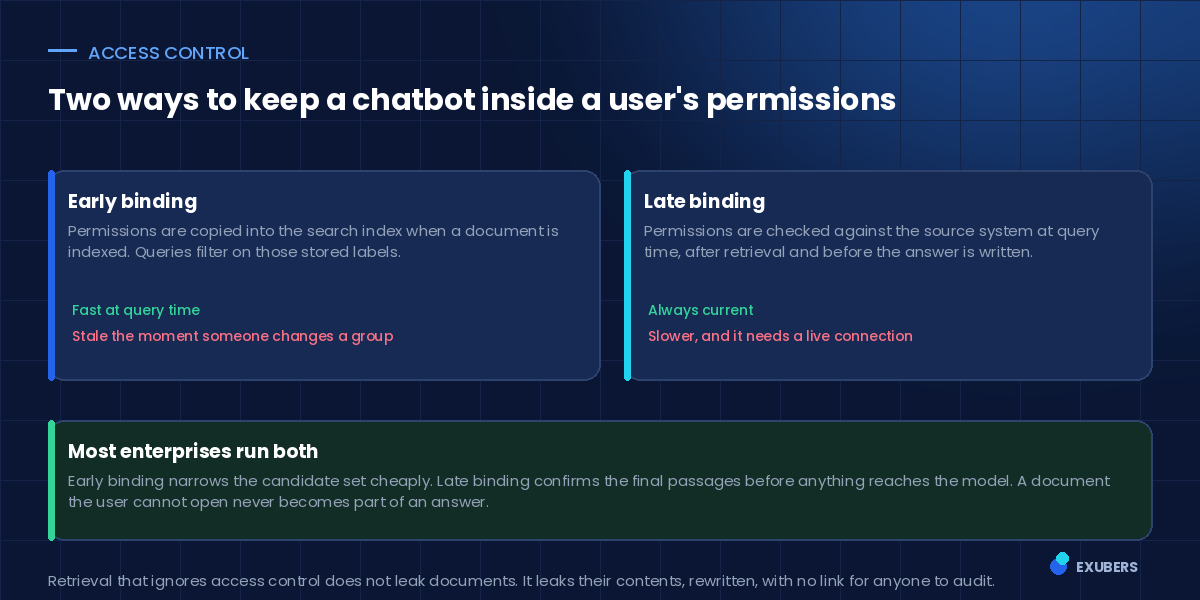
There are two established ways to enforce access in a retrieval layer. Both are valid, and the choice depends on how quickly your permissions change.
Permissions are copied into the search index when a document is indexed. Every chunk carries the groups allowed to read it. At query time the search filters on those stored labels.
This is fast, because the filter runs inside the index. However, it is only as current as the last sync. If someone leaves a project on Monday and the index refreshes on Friday, your permission-aware AI chatbot is wrong for four days.
Permissions are checked against the source system at query time, after retrieval and before the answer is written. Nothing is trusted from the index.
This is always current, which is exactly what you want for sensitive material. The cost is latency and a dependency on the source system being available. In practice you also need caching, or every question becomes several API calls.
Most mature deployments combine them. Early binding narrows the candidate set cheaply. Late binding then confirms the final handful of passages before anything reaches the model. You get index-speed filtering with source-of-truth accuracy, and the extra check applies to only a few documents per query.
Access control answers “who”. Residency answers “where”. Both belong in the same conversation, because a permission-aware AI chatbot that ships every query to another continent has solved one problem and created another.
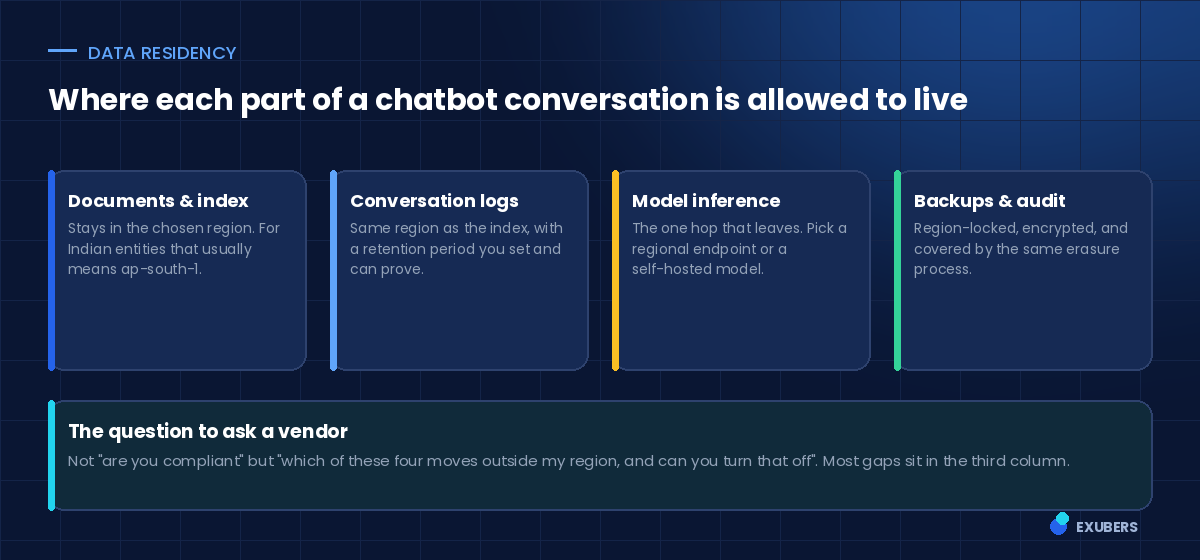
There are four components to place, and teams usually only ask about the first.
The easiest to control. Keep both in your chosen region. For Indian entities that normally means an Indian region such as ap-south-1, and most serious platforms support it.
These contain personal data, often more of it than the source documents. Store them in the same region, with a retention period you set and can evidence.
This is the hop that usually leaves the country, and it is the one to interrogate. Ask which endpoint processes the prompt, whether a regional endpoint is available, and whether prompts are retained for training. A self-hosted or regionally deployed model removes the question entirely, at some cost in capability.
Finally, backups drift. They get replicated for durability and quietly land elsewhere. Region-lock them, encrypt them, and make sure your erasure process reaches them.
India’s Digital Personal Data Protection Act was passed in 2023, and the Digital Personal Data Protection Rules were notified on 14 November 2025, with obligations phasing in from that date. The Act allows penalties of up to 250 crore rupees for failing to take reasonable security safeguards, which is why this has the attention of boards rather than only engineers.
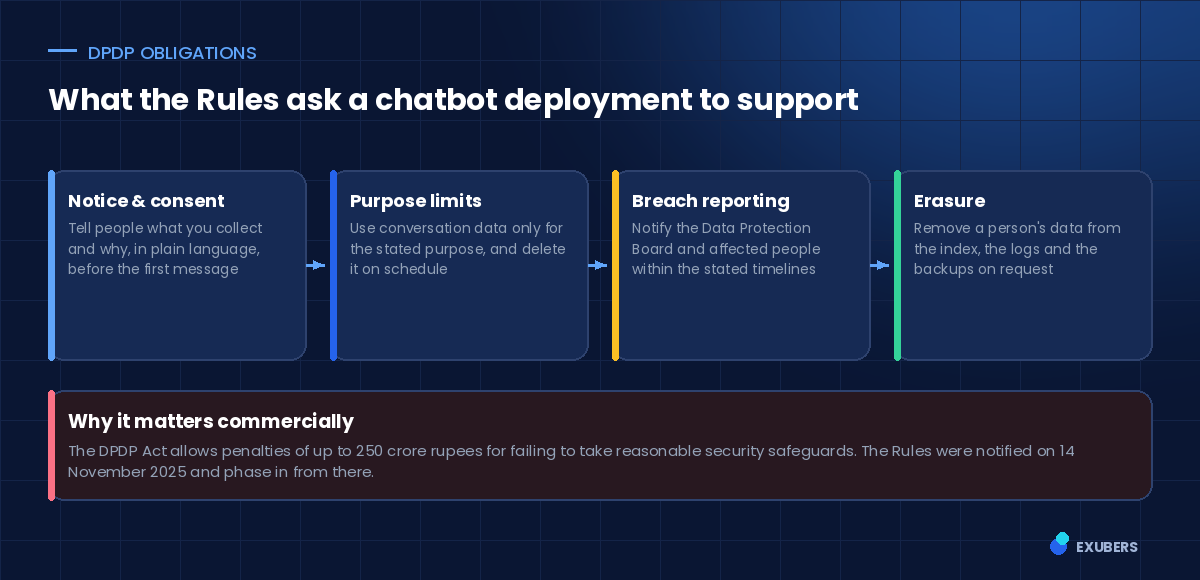
Four obligations translate directly into things your assistant must be able to do. Treat them as functional requirements, not policy documents.
People must be told what you collect and why, in clear language, before the conversation starts. For an assistant that means a visible notice at the point of first contact, and a record of what each person was shown.
Conversation data may be used for the purpose you stated, and kept only as long as needed. So your platform needs a configurable retention period, and it needs to actually enforce it rather than logging forever by default.
You must notify the Data Protection Board and affected individuals within the stated timelines. That requires knowing what a breach touched, which in turn requires proper audit logging of conversations, configuration changes and access decisions.
When someone asks for their data to be removed, it has to leave everywhere. Primary storage, conversation logs, the search index, embeddings and backups. This is the requirement that catches most vendors, because embeddings are easy to forget and hard to reverse.
If you are specifying a permission-aware AI chatbot, these are the properties to write into the requirements rather than assume.
Platforms designed for regulated deployments make several of these standard. Intellowork enforces source-level access control during retrieval, offers data residency with an Indian region by default and EU or US options, supports single sign-on through Keycloak, Azure AD, Okta and generic providers with group-to-role mapping, and keeps audit logs of both configuration changes and conversations alongside retention and erasure controls. Every answer also names its source document, section and paragraph, which is what makes an access review possible at all.
Descriptions help, but a concrete layout helps more. Here is the shape we deploy most often for a permission-aware AI chatbot inside an Indian enterprise.
The user signs in through your existing provider. The assistant receives a token carrying the user identifier and group claims. Nothing downstream ever guesses who is asking, because that guess is the root of most access failures.
The index stores access labels alongside every chunk, refreshed on a schedule matched to the sensitivity of each source. Queries filter on those labels first. The top candidates are then confirmed against the source system before the answer is written.
Some documents are readable but contain fields that are not. Salary figures, identifiers, health details. A field-level rule masks those before the passage reaches the model, so a permission-aware AI chatbot can quote a policy without quoting a person.
Every reply stores the question, the passages used, the permission decision and the confidence score. This record is what makes an access review, a breach assessment or a customer complaint answerable months later.
Finally, one process removes a person from primary storage, transcripts, index chunks and embeddings. Run it on a schedule as well as on request, so retention limits enforce themselves rather than relying on someone remembering.
Teams worry that access control will make the assistant slow or expensive. In our experience the cost is modest and the alternative is far worse.
Late binding adds latency, typically in the low hundreds of milliseconds when the confirmation covers only the final passages. Caching group membership for a short window removes most of the repeated calls. Users rarely notice the difference, because retrieval and generation dominate the response time anyway.
The real cost is design time. Someone has to map sources to groups, decide refresh intervals per source, and define the field-level rules. That work takes days, not months, and it is the difference between a permission-aware AI chatbot and an assistant that quietly reads everything.
This is the most frequent problem we find in a permission-aware AI chatbot audit. A connector indexed a shared drive with no access labels, so every document became readable by everyone with access to the assistant. Nothing looks wrong until someone asks the right question.
Some deployments filter results after the model has written the answer. The restricted content still reached the model, and often still influences the wording. This is a permission-aware AI chatbot in name only.
Early binding with a weekly sync is fine for a public help centre and unacceptable for HR content. Match the refresh interval to the sensitivity of the source, rather than using one schedule for everything.
Embeddings derived from personal data are still derived from personal data. Include them in retention and erasure processes, and store them in the same region as the source.
If you cannot reconstruct which passages produced an answer six months ago, you cannot respond properly to a complaint or an incident. Keep the citation trail with the transcript.
Ask for demonstrations rather than statements. Each of these is straightforward to show in a live system, and difficult to fake.
It is an assistant whose retrieval layer checks the asker’s identity and permissions before selecting any content, so a user never receives an answer built from documents they could not open themselves. The check happens before the model sees the text, not after it writes a reply.
Late binding is more accurate, early binding is faster, and most enterprises use both. Sensitive sources such as HR or finance content justify a live check. Public help articles do not need one.
The Act does not impose a blanket localisation requirement, though the government may restrict transfers to specific countries and sectoral rules may apply. Many Indian enterprises still choose an Indian region for documents, logs and backups because it simplifies the compliance story considerably.
Often yes, with care. Use an enterprise agreement that excludes training on your prompts, choose a regional endpoint where one exists, and document the transfer. If the content is highly sensitive, a self-hosted model removes the question.
Store a stable link between each embedding and its source record. When erasure is requested, delete the source, the derived chunks and their embeddings together, then rebuild any affected index segment. Test the process, because this is where most implementations fall short.
If it only answers from public documentation, access control matters less, though consent, retention and erasure still apply to the conversation itself. The moment the assistant can look up an account or reach internal content, permission-aware retrieval becomes essential.
A permission-aware AI chatbot is not a product you switch on. It is a set of decisions about identity, sources and residency that you make once and then enforce. Start with an inventory. List every source your assistant can reach, who may read each one, and how quickly those permissions change. That single table usually reveals the gap before any code is written.
From there the work is ordinary engineering: identity, filtering, residency, logging and erasure. Our AI and NLP engineering and enterprise search teams build these layers together, because access control belongs in retrieval rather than bolted on afterwards.
If you would like a review of an assistant you already run, get in touch. We will look at what it can reach today and tell you plainly where the boundaries leak.
Read next: an HR policy chatbot that answers without exposing personal records.

Yatin Chaudhary writes on enterprise search, AI retrieval and platform engineering at Exubers Technologies, where the team builds search, AI, cloud and DevOps systems for enterprises across India and the GCC.
RAG accuracy is two scores, not one. See how to build a gold question set, measure both halves, and set release gates that hold.
A multilingual AI chatbot answers a Hindi question from English documents. Here is the architecture, the testing method and a…
A voice AI agent answers support calls from your own documents. See the stack, the latency budget and a safe rollout plan.
Tell us what you are trying to ship. We will tell you what it actually takes — scope, sequence and the risks worth knowing about before you commit budget.