
AI Chatbots
Multilingual AI Chatbot for Indian Enterprises: A Practical Guide
A multilingual AI chatbot answers a Hindi question from English documents. Here is the architecture, the testing method and a…
RAG accuracy is two scores, not one. See how to build a gold question set, measure both halves, and set release gates that hold.
 By Yatin Chaudhary
8 min read
By Yatin Chaudhary
8 min read
RAG accuracy is not one number, and treating it as one is why so many chatbot projects stall after the demo. A retrieval system can find the right page and still produce a poor answer. It can also write a lovely answer from the wrong page.
So you need two scores, a fixed set of questions, and a gate that blocks a release when either score drops. This guide shows how to build all three without a research team.
Retrieval augmented generation has two moving parts. Search finds passages. A model then writes an answer from them. If you have not met the pattern yet, our primer on what RAG means in AI explains the basics.
When an answer goes wrong, you must know which half failed. Otherwise your team tunes prompts for a week while the real problem sits in chunking.
Therefore measure the halves separately. Only then does a single headline number mean anything.
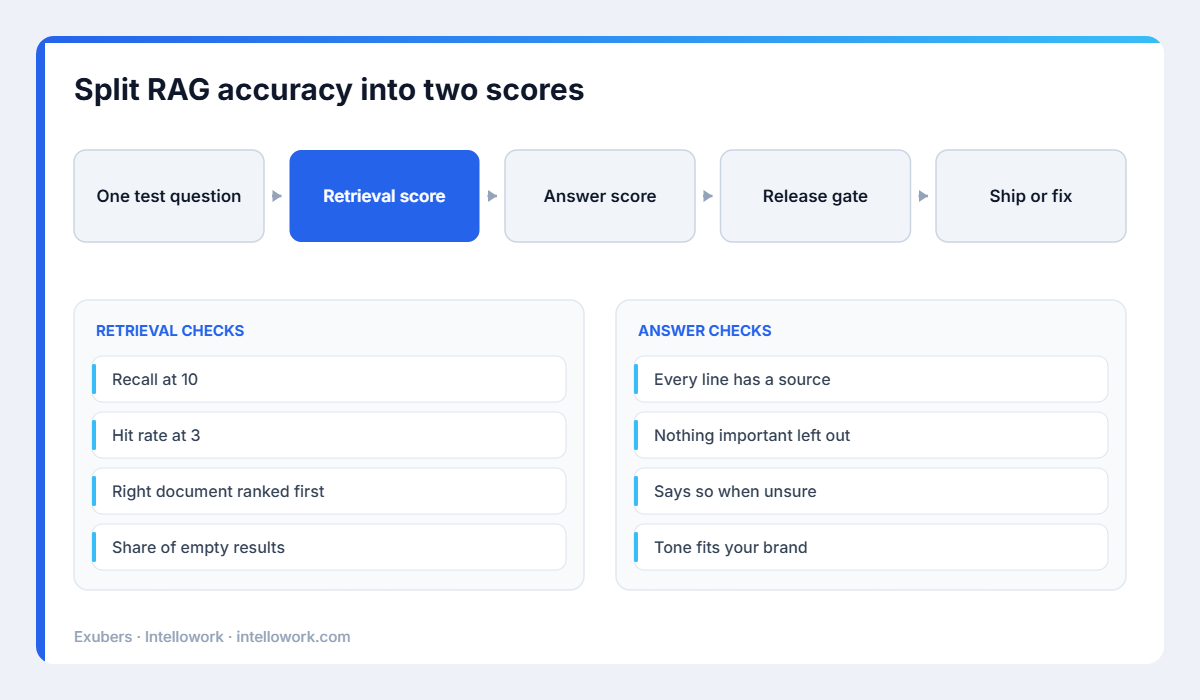
First, the retrieval score asks one question: did the right passage reach the model? The answer score asks a different one: given those passages, is the reply true, complete and clear?
Low retrieval and low answer scores mean your index needs work. Good retrieval with a weak answer usually points at the prompt or the model. Good answers with weak retrieval means you got lucky, so do not celebrate.
Of course, everything rests on this set. Without it, you are judging by vibes and by whichever question the CEO tried this morning.
| Question type | How many | What it catches |
|---|---|---|
| Common questions from real tickets | 60 | Daily traffic and obvious gaps |
| Questions with an exception or a condition | 15 | Passages split at the wrong place |
| Questions that need two documents | 10 | Weak reranking and thin context |
| Questions with no answer in your content | 10 | Whether the bot refuses politely |
| Near duplicate questions worded differently | 5 | Brittle keyword matching |
Beside each question, record the ideal answer and the document that holds it. That second column is what makes retrieval measurable at all.
| Metric | What it means | Healthy range |
|---|---|---|
| Recall at 10 | The right passage appears in the top ten | Above 90 percent |
| Hit rate at 3 | It appears in the top three | Above 80 percent |
| Mean reciprocal rank | How high the right passage sits | Above 0.7 |
| Empty result rate | Searches that return nothing useful | Under 5 percent |
Recall at 10 is the number to fix first, because the model cannot use what it never received. Chunk size, hybrid search and reranking all move it. Our note on hybrid search covers the biggest single lever.
Now judge the reply itself. Four checks cover most of what people care about.
Grounding is the one to guard hardest. An ungrounded answer is a confident invention, and one of those costs more trust than ten refusals. We wrote separately about how to stop AI chatbot hallucinations.
People score first. Take three reviewers, give them the question, the reply and the ideal answer, and ask for a simple verdict: correct, partly correct, or wrong.
Keep the scale small, since a ten point scale only creates arguments. Also rotate reviewers, because the person who wrote the prompt cannot judge it fairly.
A hundred questions with three reviewers takes about two hours. That is one afternoon a week, and it is the cheapest quality investment in the project.
Manual review does not scale past a few hundred questions. So once your people have scored two rounds, hand the routine work to a model.
Then give the judge model the question, the retrieved passages, the reply and the ideal answer. Ask for a verdict plus a one line reason. The reason matters, since it lets you spot a judge that drifts.
Check the judge against your people every month. If they agree on more than 90 percent of cases, trust it for weekly runs. Otherwise tighten the instructions and try again.
| Gate | Threshold | If it fails |
|---|---|---|
| Recall at 10 | 90 percent | Fix chunking, add hybrid search, rerank |
| Grounded answers | 95 percent | Tighten the prompt, force citations |
| Correct refusals | 90 percent | Add a confidence threshold |
| Wrong answers | Under 2 percent | Block the release |
| Change against last run | No drop above 3 points | Investigate before shipping |
Write these numbers down before the first test run. Thresholds chosen after seeing the results always drift downward, and everybody knows it.
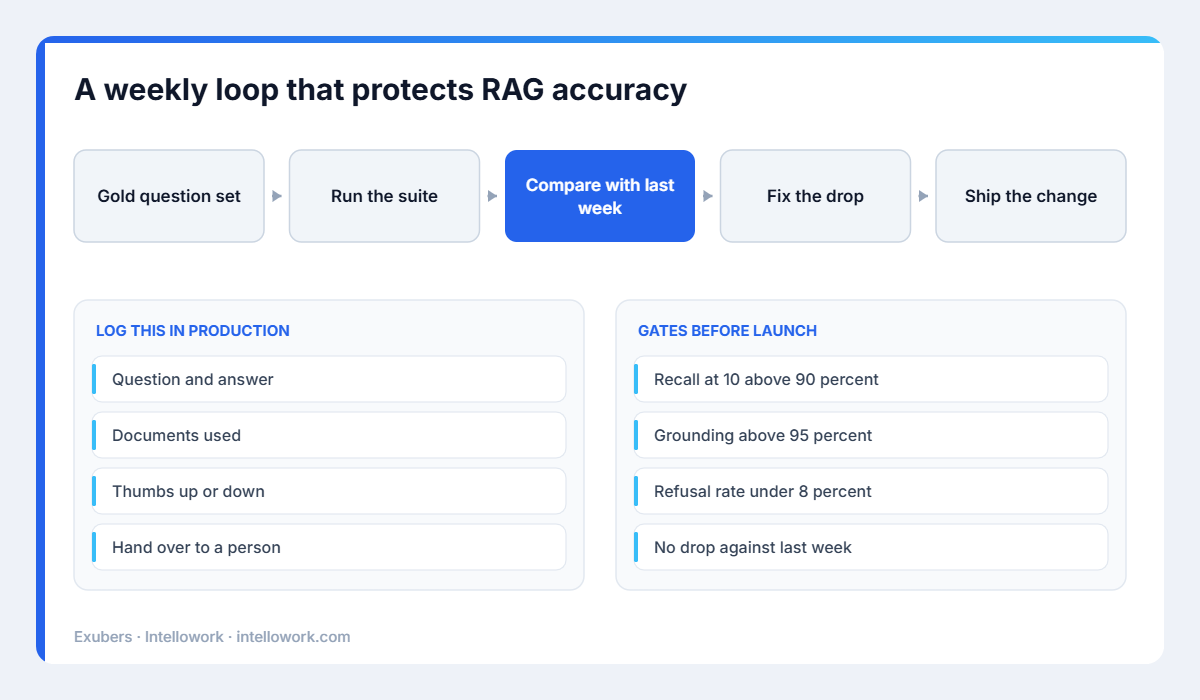
Meanwhile, content changes, models change and prompts get edited on a Friday evening. So run the gold set weekly and compare against the previous score.
Keep every run in a simple table with the date, the change and both scores. Six months later, that table tells you exactly which change hurt, which is impossible to reconstruct from memory.
Our checklist on how to test an AI chatbot before launch turns this loop into a release process.
Test sets tell you what you thought to ask. Production tells you what people really ask, so log both.
Four signals are enough at the start. Thumbs up and down give a direct read. Repeat questions within one session show weak answers. Hand overs to a person mark the coverage edge. Finally, searches that return nothing name the missing content.
Also review the worst twenty conversations every week. Add the interesting ones to the gold set, and your test set slowly becomes a mirror of real traffic.
Some habits make the numbers look great while users stay unhappy.
For an internal knowledge assistant on reasonably clean content, expect recall at 10 above 90 percent, grounding above 95 percent, and wrong answers under 2 percent after a few rounds of tuning.
First runs look worse. A recall score near 60 percent on day one is normal, and it usually climbs fast once chunking and reranking get attention. Still, judge progress against your own baseline rather than against a vendor slide.
Most teams reach for a better model when the score disappoints. Chunking usually pays more, and it costs nothing but an afternoon.
Split documents at their headings rather than at a fixed character count. A rule and its exception then stay in the same passage, so the model sees the full picture.
Keep passages between 300 and 800 words for policy content. Shorter pieces lose context, while longer ones bury the answer in noise. Also carry the document title and section name into every passage, because those few words lift retrieval more than any prompt tweak.
Re-run the gold set after each chunking change. You will often see recall jump ten points in one step, which no prompt edit will ever match.
Projects drift when nobody owns the number. So name one person, usually the product owner rather than an engineer.
That person runs the weekly evaluation, reviews the worst twenty conversations, and decides whether a release ships. Engineers fix what the report shows, while content owners fix the documents behind the failures.
Finally, share the score openly with the wider team each week. Once people see RAG accuracy move with their own content edits, they start writing better documents without being asked.
The bill is small, which surprises most finance teams.
A weekly run over a hundred questions costs a few hundred rupees in model calls. Human review takes two hours, and the setup takes a day or two once the gold set exists.
Still, compare that with the cost of a wrong refund rule reaching five thousand people. Evaluation is the cheapest insurance in the whole project.
Intellowork ships with an evaluation workspace, so the gold set, the weekly runs and the score history live beside the index itself.
Every answer stores its sources, which makes grounding checks automatic rather than manual. Teams see the score per department too, since HR content is often clean while field SOPs are not.
If you would like to see your own RAG accuracy measured on your own documents, talk to our team. We usually run a first evaluation within a week.
A hundred well chosen questions beat a thousand random ones. Add ten each week from real traffic, and the set stays useful for years.
Partly. You can score grounding and refusals without them, yet completeness needs a reference. So write the ideal answers for at least the top fifty questions.
Weekly, plus before every release. Anything less and a quiet content change will surprise you in front of users.
Yes for routine runs, once it agrees with your reviewers on more than 90 percent of cases. Keep a monthly manual check as a control.
Look at content first, since most drops follow a document change or a new folder. Then check the index, and only after that the prompt.
No. When retrieval is weak, a bigger model writes a more fluent wrong answer. Fix search first, because that is where the cheap gains are.
The short version: measure retrieval and answers separately, write your gates before you see the numbers, and run the same questions every week. RAG accuracy then stops being a debate and becomes a dial your team can turn.

Yatin Chaudhary writes on enterprise search, AI retrieval and platform engineering at Exubers Technologies, where the team builds search, AI, cloud and DevOps systems for enterprises across India and the GCC.
A multilingual AI chatbot answers a Hindi question from English documents. Here is the architecture, the testing method and a…
A voice AI agent answers support calls from your own documents. See the stack, the latency budget and a safe rollout plan.
A repeatable way to test an AI chatbot before launch: build a golden question set, score retrieval and grounding separately, and…
Tell us what you are trying to ship. We will tell you what it actually takes — scope, sequence and the risks worth knowing about before you commit budget.