AI & Automation
Voice AI Agent for Customer Support: A Practical Build Guide
A voice AI agent answers support calls from your own documents. See the stack, the latency budget and a safe rollout plan.
Artificial Intelligence is transforming how businesses access information, automate workflows, and improve productivity. However, despite the impressive capabilities of modern AI models…
 By Yatin Chaudhary
5 min read
Updated 4 Sep 2026
By Yatin Chaudhary
5 min read
Updated 4 Sep 2026
Artificial Intelligence is transforming how businesses access information, automate workflows, and improve productivity. However, despite the impressive capabilities of modern AI models, they still face a major challenge: they do not always know your organization’s data.
A large language model can generate human-like responses, but it cannot automatically access your company’s latest documents, policies, customer records, or internal knowledge unless it is connected to those systems.
This limitation often results in outdated responses, missing context, or AI hallucinations.
To solve this problem, enterprises are increasingly adopting Retrieval-Augmented Generation (RAG).
RAG has become one of the most important technologies behind modern enterprise AI assistants, knowledge chatbots, and intelligent search solutions.
In this guide, you’ll learn what RAG in AI is, how it works, why businesses are adopting it, and how it helps organizations build secure and accurate AI systems.
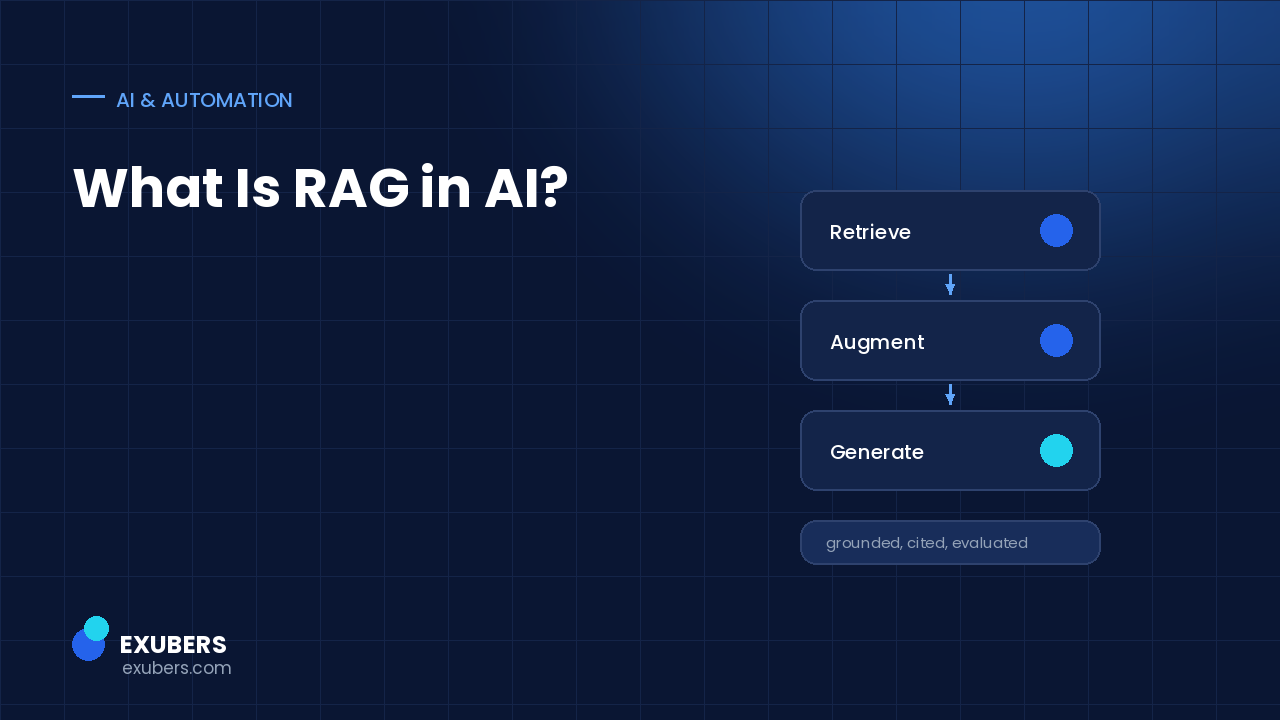
RAG stands for Retrieval-Augmented Generation.
It is an AI architecture that combines the reasoning capabilities of large language models (LLMs) with real-time information retrieval from trusted data sources.
Instead of relying only on information learned during training, a RAG system first searches relevant documents and then uses that information to generate an answer.
This allows AI systems to provide responses based on current and verified business data rather than assumptions.
Simply put:
Traditional AI = Answers from memory
RAG AI = Answers from memory + real-time company knowledge
This makes RAG especially valuable for enterprise environments where information changes frequently.
Large language models are trained on vast datasets, but they have several limitations.
A standard AI model cannot automatically access:
Without access to organizational data, responses may be incomplete.
AI models only know information available during training.
They may not be aware of recent updates, business changes, or newly created documents.
One of the biggest concerns with AI is hallucination.
When an AI model lacks relevant information, it may generate answers that sound convincing but are inaccurate.
For businesses, inaccurate information can create operational risks.
Retrieval-Augmented Generation introduces an additional layer before AI generates a response.
An employee asks:
“What is our employee reimbursement policy?”
The system searches connected data sources such as:
Relevant documents are retrieved instantly.
The retrieved information is provided to the AI model as context.
The AI generates a response based on actual company information rather than relying solely on pre-trained knowledge.
The result is a more accurate and trustworthy answer.
A RAG solution connects with enterprise systems that store organizational knowledge.
Examples include:
Documents are converted into numerical representations called embeddings and stored in a vector database.
This enables semantic search instead of simple keyword matching.
The retrieval engine identifies the most relevant information related to a user’s query.
The language model uses retrieved content to generate accurate responses.
Together, these components create an intelligent AI knowledge system.
Responses are grounded in real business information.
This significantly reduces hallucinations.
Employees receive answers based on the latest available data.
Organizations can control which information is accessible based on permissions.
Employees no longer need to manually search through multiple systems.
Teams spend less time searching and more time executing meaningful work.
RAG enables organizations to make enterprise knowledge accessible across departments.
Traditional search systems provide a list of documents that employees must manually review.
RAG-powered systems go further.
| Feature | Traditional Search | RAG-Powered Search |
|---|---|---|
| Keyword Matching | Yes | Yes |
| Semantic Understanding | Limited | Advanced |
| Context Awareness | Low | High |
| Direct Answers | No | Yes |
| Conversational Experience | No | Yes |
| AI-Powered Insights | No | Yes |
| Knowledge Retrieval | Basic | Intelligent |
This is why many organizations are replacing traditional search experiences with AI-powered knowledge assistants.
Many businesses ask whether they should use RAG or fine-tuning.
The answer depends on the use case.
For most enterprise knowledge management use cases, RAG is often the preferred approach.
Employees can instantly access policies, benefits information, and onboarding resources.
Teams can retrieve troubleshooting guides and technical documentation without waiting for support staff.
Sales representatives gain immediate access to pricing documents, proposals, and product information.
Support teams can access updated knowledge bases and issue resolution procedures.
Employees can quickly retrieve SOPs, compliance documents, and process guidelines.
Businesses are generating more data than ever before.
The challenge is no longer collecting information—it is making information accessible.
RAG helps organizations bridge the gap between AI capabilities and enterprise knowledge.
By combining intelligent retrieval with generative AI, businesses can create systems that are accurate, scalable, and secure.
This is why many modern enterprise AI assistants, workplace chatbots, and knowledge platforms rely on RAG as their core architecture.
Intellowork leverages Retrieval-Augmented Generation to help organizations access information instantly across their business systems.
By connecting documents, collaboration platforms, databases, and enterprise applications, Intellowork transforms fragmented knowledge into actionable answers.
With AI-powered search, role-based access controls, and enterprise-grade security, Intellowork enables organizations to:
Instead of manually searching through multiple systems, employees simply ask questions and receive accurate answers powered by trusted business data.
RAG stands for Retrieval-Augmented Generation, a technique that combines information retrieval with AI-generated responses.
RAG enables AI systems to access real-time company information, improving accuracy and reducing hallucinations.
No. RAG enhances large language models by providing relevant external information before response generation.
For enterprise knowledge management and information retrieval use cases, RAG is often more flexible and easier to maintain.
Yes. RAG systems can connect to documents, databases, collaboration platforms, and knowledge repositories to provide accurate responses.
Read next: How to measure RAG accuracy before you launch.

Yatin Chaudhary writes on enterprise search, AI retrieval and platform engineering at Exubers Technologies, where the team builds search, AI, cloud and DevOps systems for enterprises across India and the GCC.
A voice AI agent answers support calls from your own documents. See the stack, the latency budget and a safe rollout plan.
What an HR policy chatbot should answer, what it must never touch, how to handle role and location variants, and the numbers that…
How to build an AI chatbot for Slack and Microsoft Teams that answers from your own documents, respects permissions, cites its…
Tell us what you are trying to ship. We will tell you what it actually takes — scope, sequence and the risks worth knowing about before you commit budget.