AI Chatbots
How to Measure RAG Accuracy Before You Launch
RAG accuracy is two scores, not one. See how to build a gold question set, measure both halves, and set release gates that hold.
Every business depends on information. Whether it's employee policies, project documentation, customer records, contracts, sales presentations, or operational procedures, access to accurate…
 By Yatin Chaudhary
5 min read
Updated 1 Sep 2026
By Yatin Chaudhary
5 min read
Updated 1 Sep 2026
Every business depends on information. Whether it’s employee policies, project documentation, customer records, contracts, sales presentations, or operational procedures, access to accurate information is critical for productivity and decision-making.
However, as organizations grow, information becomes scattered across multiple platforms. Employees often spend valuable time searching through folders, emails, cloud drives, chat applications, and internal systems just to find the information they need.
For years, businesses relied on traditional search tools to locate information. While these tools worked reasonably well in simpler environments, they struggle to meet the demands of today’s digital workplace.
This is where enterprise search is transforming the way organizations access and utilize knowledge.
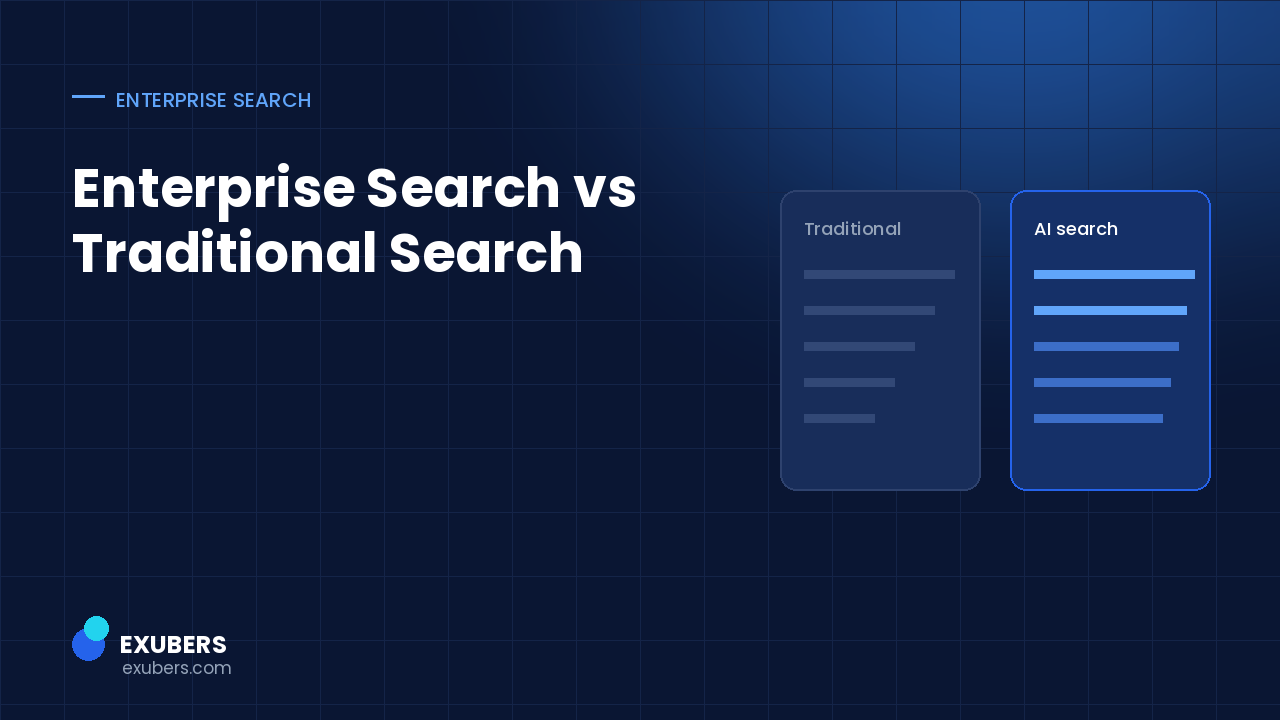
In this guide, we’ll compare enterprise search vs traditional search, explore their key differences, and understand why AI-powered enterprise search is becoming essential for modern businesses.
Traditional search systems are designed to locate information based on keyword matching.
When users enter a query, the search engine scans available content and returns a list of documents, files, or webpages that contain matching terms.
Examples of traditional search include:
Traditional search relies heavily on exact keywords, document names, metadata, and indexing structures.
While useful, it often creates challenges when users don’t know the exact terms used in a document.
Traditional search was designed for a time when business data was stored in fewer systems.
Today’s organizations operate across dozens of applications, creating several challenges.
Business information is distributed across:
Traditional search tools typically operate within a single platform and cannot provide a unified search experience.
Users must often know the exact keyword, file name, or phrase to locate information.
If the search query doesn’t match indexed content, relevant information may never appear.
Traditional search engines provide a list of documents rather than direct answers.
Employees must manually open files, review content, and identify relevant information themselves.
Searching across multiple platforms leads to frustration, delays, and reduced productivity.
Enterprise search is an advanced search solution that enables employees to find information across all organizational systems from a single interface.
Modern enterprise search platforms use artificial intelligence, natural language processing, and contextual understanding to deliver relevant answers rather than just document links.
Employees can ask questions such as:
Instead of displaying hundreds of documents, enterprise search delivers the most relevant answer instantly.
Modern enterprise search solutions combine multiple technologies to improve information retrieval.
Enterprise search platforms connect with:
This creates a centralized knowledge layer across the organization.
Employees can search using conversational language rather than exact keywords.
The system understands intent and context.
AI-powered enterprise search uses Retrieval-Augmented Generation (RAG) to retrieve relevant information before generating answers.
This improves response accuracy and reduces misinformation.
Users only receive information they are authorized to access.
Enterprise search respects existing security policies and permissions.
| Feature | Traditional Search | Enterprise Search |
|---|---|---|
| Search Method | Keyword Matching | Natural Language Understanding |
| Results | Document Lists | Direct Answers |
| Data Sources | Usually Single System | Multiple Connected Systems |
| Context Awareness | Limited | High |
| AI Capabilities | None or Minimal | Advanced AI & RAG |
| Employee Experience | Manual Search | Conversational Search |
| Productivity Impact | Moderate | High |
| Knowledge Discovery | Difficult | Intelligent & Fast |
| Security Controls | Basic | Enterprise Grade |
The difference is not simply better search results. Enterprise search fundamentally changes how employees interact with organizational knowledge.
Employees spend less time searching and more time executing tasks.
Teams gain instant access to the information they need without switching between applications.
Enterprise search creates a unified information experience across departments and platforms.
Employees become more self-sufficient and less dependent on colleagues for routine information.
Access to accurate information enables faster and more informed business decisions.
New hires can quickly learn processes, policies, and workflows using AI-powered search.
The amount of enterprise data continues to grow every year.
Organizations need more than keyword matching. They need intelligent systems capable of understanding questions, retrieving relevant information, and delivering actionable answers.
AI-powered enterprise search enables businesses to:
As AI becomes a standard business capability, enterprise search is quickly becoming a strategic investment rather than an optional tool.
Intellowork helps organizations transform fragmented information into a unified knowledge experience.
By connecting with existing business applications, documents, databases, and collaboration tools, Intellowork enables employees to find answers instantly using natural language.
With advanced AI search capabilities, enterprise-grade security, and role-based access controls, Intellowork helps businesses:
Instead of searching through multiple systems, employees simply ask questions and receive accurate answers in seconds.
Traditional search systems were built for a different era of work.
Modern organizations require intelligent solutions capable of understanding context, connecting data sources, and delivering immediate answers.
Enterprise search represents the next evolution of workplace productivity.
Businesses that adopt AI-powered search today will be better equipped to manage growing volumes of information, improve employee experiences, and make faster, smarter decisions.
Traditional search relies on keyword matching and typically returns document lists. Enterprise search uses AI to understand intent, search across multiple systems, and provide direct answers.
Enterprise search helps employees access information quickly, reduces knowledge silos, and improves overall productivity.
Yes. Modern enterprise search solutions integrate with platforms such as SharePoint, Google Drive, Slack, Teams, Confluence, CRM systems, and more.
Enterprise-grade solutions include role-based access controls, encryption, audit logs, and permission-based information retrieval.
AI enables contextual understanding, natural language queries, answer generation, and more accurate information retrieval through technologies like RAG.

Yatin Chaudhary writes on enterprise search, AI retrieval and platform engineering at Exubers Technologies, where the team builds search, AI, cloud and DevOps systems for enterprises across India and the GCC.
RAG accuracy is two scores, not one. See how to build a gold question set, measure both halves, and set release gates that hold.
A multilingual AI chatbot answers a Hindi question from English documents. Here is the architecture, the testing method and a…
A repeatable way to test an AI chatbot before launch: build a golden question set, score retrieval and grounding separately, and…
Tell us what you are trying to ship. We will tell you what it actually takes — scope, sequence and the risks worth knowing about before you commit budget.