AI Chatbots
How to Measure RAG Accuracy Before You Launch
RAG accuracy is two scores, not one. See how to build a gold question set, measure both halves, and set release gates that hold.
Modern businesses generate enormous amounts of information every day. Employee policies, technical documentation, customer records, contracts, product specifications, project files, support…
 By Yatin Chaudhary
19 min read
Updated 4 Sep 2026
By Yatin Chaudhary
19 min read
Updated 4 Sep 2026
Modern businesses generate enormous amounts of information every day.
Employee policies, technical documentation, customer records, contracts, product specifications, project files, support tickets, sales presentations, and internal communications are often distributed across multiple business applications.
Finding the right information should be simple.
However, traditional enterprise search systems often struggle because employees do not always know the exact keywords, document titles, or file locations they need.
At the same time, AI-powered semantic search can understand meaning and user intent, but it may sometimes overlook exact terms that are important to the query.
This creates an important challenge:
Should businesses use keyword search or semantic search?
The answer is often neither one alone.
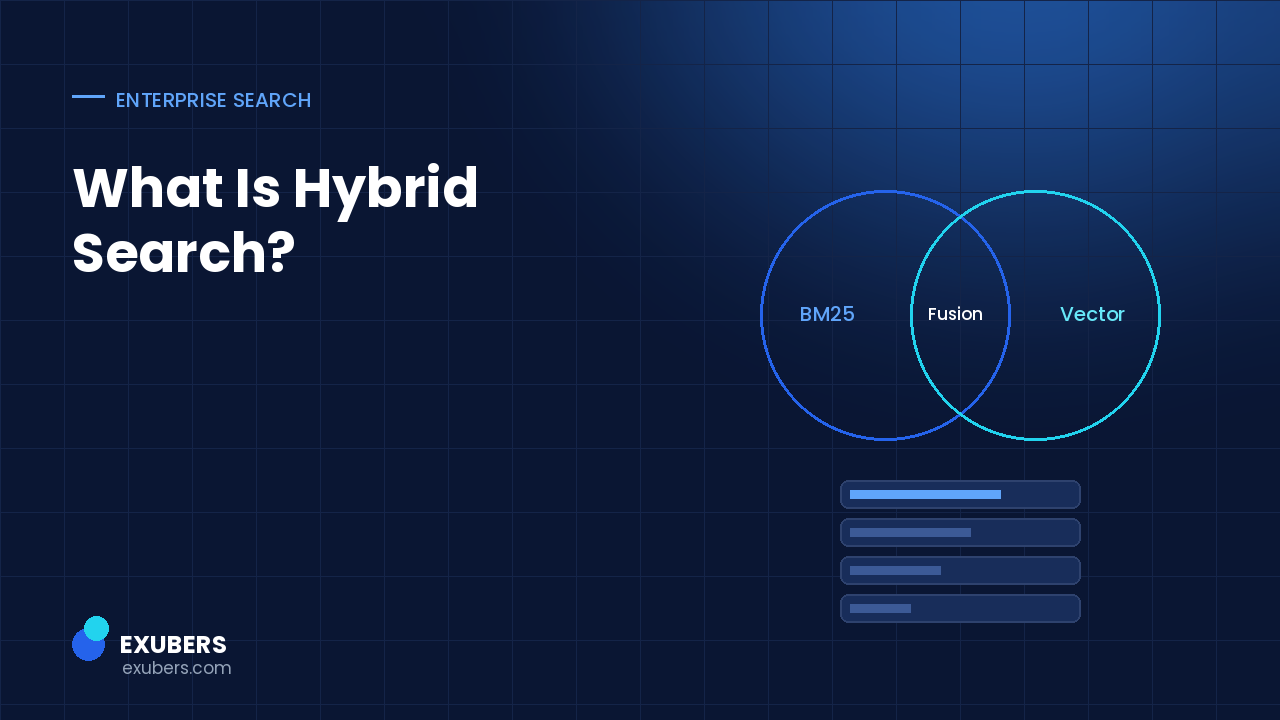
Modern Enterprise AI platforms increasingly use Hybrid Search, which combines the strengths of both approaches.
Hybrid Search combines precise keyword matching with semantic understanding. This enables search systems to find exact information while also understanding the meaning and context behind a user’s request.
In this guide, you will learn what Hybrid Search is, how it works, why it is important for Enterprise AI, and how it improves search accuracy in RAG-powered applications.
Hybrid Search is an AI-powered search method that combines:
Keyword Search identifies exact words, phrases, IDs, names, and technical terms.
Semantic Search understands meaning, context, intent, and relationships between concepts.
By combining both methods, Hybrid Search delivers results that are more accurate and relevant than using either approach independently.
For example, an employee may search:
“Show me the latest ISO 27001 security policy.”
A keyword search can identify the exact phrase ISO 27001.
Semantic Search can understand that the employee is looking for information related to:
Hybrid Search combines these signals to retrieve the most relevant document.
Keyword Search has powered search engines for decades.
It works by matching the words in a user’s query with words stored in documents or databases.
For example, if an employee searches:
“Travel reimbursement policy”
a keyword search engine looks for documents containing:
This approach is useful when users know the exact terminology.
However, it has several limitations.
Employees may use different words than the document author.
For example, a user may search:
“Work from home rules”
while the document is titled:
“Hybrid Workplace Guidelines”
A traditional keyword search may fail to identify the relationship.
Keyword Search sees words but does not always understand what the user wants.
For example:
“Apple security policy”
could refer to:
Without contextual understanding, results may be inaccurate.
Common keywords may appear across hundreds of documents.
Employees may need to open multiple files before finding the correct information.
This increases search time and reduces productivity.
Semantic Search understands meaning rather than relying only on exact keywords.
It uses technologies such as:
Semantic Search is highly effective for natural language questions.
For example:
“How can I claim business travel expenses?”
It can retrieve documents titled:
even if they do not contain the exact words used in the query.
However, Semantic Search also has limitations.
Some business queries require exact matches.
Examples include:
Semantic similarity alone may not provide the required precision.
A semantic system may retrieve conceptually related documents that are not the best answer.
For example, a search for:
“AWS security architecture”
may return general cloud security documentation instead of the specific AWS architecture document.
Technical, legal, medical, and financial industries often use specialized terminology.
Exact keyword matching can remain important for these queries.
Hybrid Search combines the strengths of keyword and semantic retrieval.
Instead of choosing between precision and meaning, it uses both.
The system generally follows these steps.
An employee asks:
“Find the latest employee expense policy.”
The keyword engine searches for exact terms such as:
The semantic system analyzes the intent behind the query.
It identifies related concepts such as:
The system combines keyword relevance with semantic relevance.
Documents that perform well in both searches receive stronger relevance signals.
The platform ranks the results based on factors such as:
The employee receives more accurate results without needing to search multiple systems.
| Feature | Keyword Search | Semantic Search | Hybrid Search |
|---|---|---|---|
| Exact Keyword Matching | Strong | Limited | Strong |
| Understands Meaning | No | Strong | Strong |
| Handles Synonyms | Limited | Strong | Strong |
| Supports Natural Language | Basic | Strong | Strong |
| Finds IDs and Codes | Strong | Limited | Strong |
| Context Awareness | Limited | Strong | Strong |
| Search Precision | High for exact terms | High for concepts | High across both |
| Enterprise AI Support | Limited | Strong | Strong |
| RAG Retrieval | Basic | Strong | Advanced |
Hybrid Search provides a balanced approach.
Keyword Search provides precision.
Semantic Search provides understanding.
Hybrid Search provides both.
Hybrid Search combines multiple search technologies.
Keyword Search commonly uses an inverted index.
An inverted index maps words to the documents where those words appear.
This enables fast retrieval of exact terms.
AI converts text into numerical representations called embeddings.
Embeddings capture meaning and relationships between concepts.
For example:
may be represented as closely related concepts.
Vector Search compares the mathematical representations of queries and documents.
It identifies information with similar meaning even when different words are used.
Hybrid Search combines keyword and semantic scores.
The system may assign different importance levels to each signal depending on the use case.
For example:
A search for an invoice number may prioritize keyword matching.
A search for “How do I submit expenses?” may prioritize semantic understanding.
Enterprise AI systems need accurate information.
If the retrieval process is weak, AI-generated answers may be incomplete, outdated, or irrelevant.
Hybrid Search improves retrieval by combining exact matching with contextual understanding.
This makes it valuable for:
Hybrid Search helps Enterprise AI retrieve the right information before generating an answer.
Retrieval-Augmented Generation, or RAG, allows AI models to use enterprise information while answering questions.
A typical Hybrid Search RAG workflow looks like this:
This approach improves answer quality and helps reduce AI hallucinations.
Enterprise information is complex.
Some searches require exact precision.
Other searches require contextual understanding.
A single search method cannot always handle both effectively.
Hybrid Search enables organizations to create intelligent search experiences that adapt to different types of queries.
Employees can search naturally while the platform still recognizes important business terms, IDs, product names, policies, and technical references.
This creates a more reliable and efficient Enterprise Search experience.
Hybrid Search combines the precision of keyword search with the contextual understanding of semantic search.
This combination helps organizations deliver more accurate and useful search experiences across large and complex knowledge repositories.
For enterprises, the benefits go beyond better search results. Hybrid Search can improve employee productivity, reduce information silos, strengthen AI applications, and support faster decision-making.
Traditional keyword search can miss relevant information when employees use different words from those used in a document.
Semantic search solves this problem by understanding meaning. However, semantic search may not always prioritize exact terms, technical codes, or business identifiers.
Hybrid Search balances both approaches.
For example, an employee searches:
“Find the latest SOC 2 compliance policy.”
Keyword Search identifies the exact term SOC 2.
Semantic Search understands related concepts such as:
Hybrid Search combines these signals and improves the chances of retrieving the most relevant and current document.
Enterprise employees do not always search in the same way.
Some queries are highly specific:
Other queries are conversational:
Hybrid Search supports both query types.
It can identify exact information while also understanding natural language and user intent.
Employees often waste time switching between applications and manually searching through folders.
Hybrid Search can bring information from multiple enterprise systems into a unified search experience.
Instead of searching separately in:
employees can use one intelligent search interface.
This reduces search time and improves productivity.
Traditional search systems may return hundreds of results.
Employees must open several documents to determine which one contains the correct information.
Hybrid Search improves ranking by considering:
As a result, employees receive more relevant information near the top of the results.
Enterprise AI systems depend on high-quality information retrieval.
If an AI assistant receives irrelevant or incomplete information, its answers may also be inaccurate.
Hybrid Search improves the retrieval stage by identifying both exact and contextually relevant information.
This helps AI assistants provide:
Employees increasingly expect workplace tools to understand natural language.
They do not want to memorize file names, folder structures, or exact business terminology.
Hybrid Search allows employees to ask questions naturally while maintaining the precision needed for enterprise information.
This creates a simpler and more intuitive search experience.
Enterprise Search connects information from multiple business systems and makes it accessible through a unified interface.
Hybrid Search improves Enterprise Search by combining two important capabilities:
Precision: Keyword Search identifies exact terms.
Understanding: Semantic Search identifies related concepts and user intent.
Together, these capabilities create a more complete search experience.
For example, an employee asks:
“Where is the updated vendor onboarding process?”
The platform can identify:
The employee receives useful information without needing to know where it is stored.
Retrieval-Augmented Generation, commonly known as RAG, allows AI systems to retrieve external or enterprise information before generating an answer.
Hybrid Search can improve RAG by increasing the quality of retrieved content.
A typical Hybrid Search RAG workflow includes the following stages.
Example:
“What are the requirements for approving a new software vendor?”
The search engine identifies important terms such as:
The AI recognizes related concepts, including:
The system combines keyword relevance with semantic similarity.
It then ranks the most useful documents.
The system retrieves relevant policies, procedures, and documentation from connected enterprise sources.
A Large Language Model uses the retrieved information to generate a context-aware answer.
The answer is based on organizational knowledge rather than only on the model’s pre-trained information.
Hybrid Search can support nearly every department inside an organization.
HR teams manage a large volume of employee information.
Hybrid Search helps employees find:
An employee can ask:
“How many paid leave days do I receive?”
The AI can retrieve the relevant policy while recognizing related terms such as annual leave, paid time off, and vacation days.
IT teams manage technical documentation that often contains exact product names, error codes, and system identifiers.
Hybrid Search can retrieve:
For example:
“How do I fix error code AUTH-403?”
Keyword Search identifies the exact error code.
Semantic Search finds related authentication and access-control documentation.
Sales professionals need fast access to current and accurate information.
Hybrid Search helps retrieve:
A salesperson can ask:
“Show me the latest enterprise pricing proposal for healthcare clients.”
The platform can understand the business context while matching exact terms related to pricing and healthcare.
Customer support teams often search multiple systems while assisting customers.
Hybrid Search can retrieve:
This can improve response speed and support consistency.
Finance teams work with exact information such as invoice numbers, budget codes, and vendor IDs.
They also need contextual access to policies and procedures.
Hybrid Search can help retrieve:
Legal teams often search for exact clauses while also reviewing related concepts.
Hybrid Search can help locate:
The combination of exact matching and contextual understanding can reduce the time required to locate relevant information.
Hybrid Search is useful across many industries because every organization manages large volumes of structured and unstructured information.
Healthcare organizations can use Hybrid Search to retrieve:
Exact terminology can be combined with contextual understanding to improve information discovery.
Financial institutions manage complex information involving:
Hybrid Search can support faster access while maintaining permission-based controls.
Manufacturing organizations can search across:
Exact equipment IDs can be combined with natural language questions.
Retail businesses can use Hybrid Search for:
Educational institutions can organize and search:
Government organizations can improve access to:
AI agents need reliable information to complete tasks.
Before an AI agent can summarize a document, answer an employee question, or recommend an action, it must retrieve the right context.
Hybrid Search improves this process by combining exact information with semantic relevance.
For example, an IT AI agent may receive the request:
“Create a support ticket for the VPN issue described in incident INC-2048.”
Keyword Search identifies the exact incident number.
Semantic Search understands the broader VPN issue and retrieves relevant troubleshooting information.
The AI agent can then use the retrieved context to support the next action.
This makes Hybrid Search an important component of intelligent enterprise workflows.
Intellowork combines Enterprise Search, Semantic Search, Vector Search, and Retrieval-Augmented Generation to help organizations access knowledge more intelligently.
Hybrid Search enables Intellowork to balance exact keyword matching with contextual understanding.
This helps employees find information whether they search using:
By connecting enterprise knowledge across business systems, Intellowork can help organizations reduce information silos and provide employees with a unified AI-powered search experience.
The platform can support use cases across HR, IT, sales, customer support, operations, finance, and other business functions.
Hybrid Search can create value in several ways.
Organizations may use it to:
The value increases when Hybrid Search is connected to trusted and up-to-date enterprise information.
Hybrid Search can significantly improve Enterprise Search and AI-powered knowledge retrieval. However, successful implementation requires more than combining a keyword search engine with a vector database.
Organizations should focus on data quality, search relevance, security, governance, and continuous optimization.
Search quality depends on the quality of the information available.
Before implementing Hybrid Search, organizations should review their knowledge repositories and:
Clean and current information improves both keyword retrieval and semantic relevance.
Employees often use multiple applications during their workday.
A useful Hybrid Search platform should connect relevant business systems, such as:
Organizations should prioritize the systems employees use most frequently.
Hybrid Search does not always require an equal balance between keyword and semantic results.
The ideal balance depends on the query and business use case.
For example:
Exact information queries may prioritize keyword search:
Conceptual queries may prioritize semantic search:
A strong Hybrid Search system can adjust the ranking strategy based on the query.
Hybrid Search should not simply combine two result lists.
The platform should rank information using multiple signals, including:
This helps employees receive the most useful information first.
Enterprise information may include confidential or restricted data.
A Hybrid Search platform should respect existing access controls.
Employees should only retrieve information they are authorized to view.
Permission-aware search supports:
Security should be integrated into the search architecture from the beginning.
Organizations should continuously evaluate how employees use search.
Useful metrics include:
Search analytics can reveal knowledge gaps and opportunities for improvement.
Organizations can reduce implementation risks by avoiding common mistakes.
AI systems can retrieve outdated content if organizations do not maintain their knowledge repositories.
Old policies may create confusion and reduce trust.
Organizations should define clear content ownership and review schedules.
Hybrid Search improves information retrieval, but it is only one part of an Enterprise AI ecosystem.
A complete enterprise solution may also require:
Some organizations focus heavily on semantic search and overlook the importance of exact terms.
Technical codes, product identifiers, legal references, and financial records may require precise keyword matching.
Hybrid Search should support both requirements.
Enterprise knowledge can contain sensitive information.
Organizations should implement:
Employees are the primary users of enterprise search.
Their feedback can reveal:
Continuous feedback helps improve search quality over time.
Enterprise AI adoption requires strong governance.
Hybrid Search systems should protect organizational information while making it easier to access.
Key security and governance capabilities include:
Users receive access based on their role and permissions.
SSO enables secure authentication through an organization’s existing identity system.
The search system should check document permissions before retrieving or displaying information.
Enterprise data should be protected during transmission and storage.
Organizations should be able to monitor search activity and AI interactions.
Clear policies should define:
Hybrid Search will continue to evolve as Enterprise AI becomes more advanced.
Future search platforms are expected to include:
Enterprise search will move beyond finding documents.
It will become an intelligent system that understands business context, recommends actions, and helps employees complete work.
AI assistants and AI agents require access to accurate organizational knowledge.
Hybrid Search provides a strong retrieval foundation by combining:
As organizations adopt more AI-powered workflows, Hybrid Search will play a critical role in connecting AI systems with trusted enterprise information.
This can support:
Hybrid Search is a search method that combines keyword search with semantic search. It uses exact keyword matching and AI-powered contextual understanding to improve search accuracy.
Hybrid Search processes a query through both keyword and semantic search systems. It then combines and ranks the results based on relevance, context, and other signals.
Semantic Search focuses on meaning and user intent.
Hybrid Search combines Semantic Search with traditional keyword matching.
This allows Hybrid Search to understand context while maintaining precision for exact terms.
Enterprise information includes both natural-language content and exact business identifiers.
Hybrid Search helps employees find information across different enterprise systems while supporting both types of queries.
Yes. Hybrid Search can improve the retrieval stage of a RAG system by combining exact keyword matches with semantically relevant content.
Better retrieval can support more accurate and relevant AI-generated responses.
Yes. Enterprise search platforms can connect with systems such as Google Workspace, Microsoft 365, SharePoint, Slack, Microsoft Teams, CRM platforms, HRMS software, internal databases, and document repositories.
Hybrid Search can support enterprise security through role-based access controls, Single Sign-On, encryption, audit logs, and permission-aware retrieval.
Intellowork combines Enterprise Search, Semantic Search, Vector Search, and Retrieval-Augmented Generation to help organizations provide accurate and context-aware access to enterprise knowledge.
Traditional keyword search provides precision, but it often struggles to understand user intent.
Semantic Search understands meaning, but it may not always prioritize exact business terms.
Hybrid Search combines the strengths of both approaches.
By using keyword precision and semantic understanding together, organizations can create search experiences that are more accurate, relevant, and useful.
For Enterprise AI, Hybrid Search improves knowledge retrieval, supports stronger RAG applications, and helps employees access trusted information faster.
As enterprise data continues to grow, businesses will need search systems that can understand both the words employees use and the meaning behind their questions.
Hybrid Search provides a practical foundation for that future.
Your organization’s knowledge should be easy to find, understand, and use.
Intellowork helps businesses connect enterprise knowledge and provide AI-powered access to information through intelligent search technologies.
By combining Enterprise Search, Semantic Search, Vector Search, and Retrieval-Augmented Generation, Intellowork can help organizations:
Book a personalized demo to discover how Intellowork can help your organization turn disconnected information into an intelligent business advantage.
Read next: how to score retrieval before you launch an assistant.
Read next: Multilingual AI chatbot for Indian enterprises.

Yatin Chaudhary writes on enterprise search, AI retrieval and platform engineering at Exubers Technologies, where the team builds search, AI, cloud and DevOps systems for enterprises across India and the GCC.
RAG accuracy is two scores, not one. See how to build a gold question set, measure both halves, and set release gates that hold.
A multilingual AI chatbot answers a Hindi question from English documents. Here is the architecture, the testing method and a…
A repeatable way to test an AI chatbot before launch: build a golden question set, score retrieval and grounding separately, and…
Tell us what you are trying to ship. We will tell you what it actually takes — scope, sequence and the risks worth knowing about before you commit budget.