AI Chatbots
How to Measure RAG Accuracy Before You Launch
RAG accuracy is two scores, not one. See how to build a gold question set, measure both halves, and set release gates that hold.
Artificial Intelligence has fundamentally changed how businesses search for information. Traditional search engines rely on matching keywords inside documents. While this approach worked…
 By Yatin Chaudhary
14 min read
Updated 1 Sep 2026
By Yatin Chaudhary
14 min read
Updated 1 Sep 2026
Artificial Intelligence has fundamentally changed how businesses search for information.
Traditional search engines rely on matching keywords inside documents. While this approach worked for many years, it struggles to understand what users actually mean.
Modern AI systems need something much smarter.
Instead of matching words, they compare meaning.
This is exactly what Vector Search enables.
Whether you’re using an Enterprise AI Assistant, an AI-powered Enterprise Search platform, or a Retrieval-Augmented Generation (RAG) application, Vector Search works behind the scenes to retrieve the most relevant information.
Without Vector Search, modern Enterprise AI would struggle to understand context, natural language, and user intent.
In this guide, you’ll learn what Vector Search is, how it works, why it’s essential for Enterprise AI, and how businesses use it to build intelligent search experiences.
Vector Search is an AI-powered search technique that retrieves information based on meaning and similarity instead of exact keyword matches.
Rather than asking:
“Does this document contain these exact words?”
Vector Search asks:
“Which documents have the closest meaning to the user’s query?”
This allows AI systems to retrieve highly relevant information even when the wording is completely different.
For example, an employee searches:
“Remote work policy.”
The actual document might be titled:
Although none of these documents contain the exact phrase “remote work policy,” Vector Search recognizes that they represent the same concept.
This is why AI-powered search feels much more intelligent than traditional keyword search.
Businesses now store millions of documents across multiple systems.
Employees often search using natural language rather than exact keywords.
Traditional search struggles because it depends on matching identical words.
Common problems include:
As enterprise data grows, these limitations become more noticeable.
Organizations need search systems that understand meaning rather than words.
Although Vector Search sounds complex, the overall process is surprisingly straightforward.
Let’s break it down step by step.
AI cannot understand plain text the way humans do.
Instead, every document and search query is converted into a numerical representation called a vector (also known as an embedding).
A vector captures the meaning of the text rather than just the words themselves.
For example:
Customer Support Guide
becomes a mathematical representation that reflects its relationship to similar topics.
Once vectors are created, they are stored inside a specialized vector database.
Unlike traditional databases, vector databases are optimized to quickly identify similar vectors.
Popular vector databases include:
These databases enable fast similarity searches across millions of documents.
When an employee asks:
“Show me the latest travel reimbursement policy.”
The AI converts that question into a vector as well.
Now both:
exist in the same mathematical space.
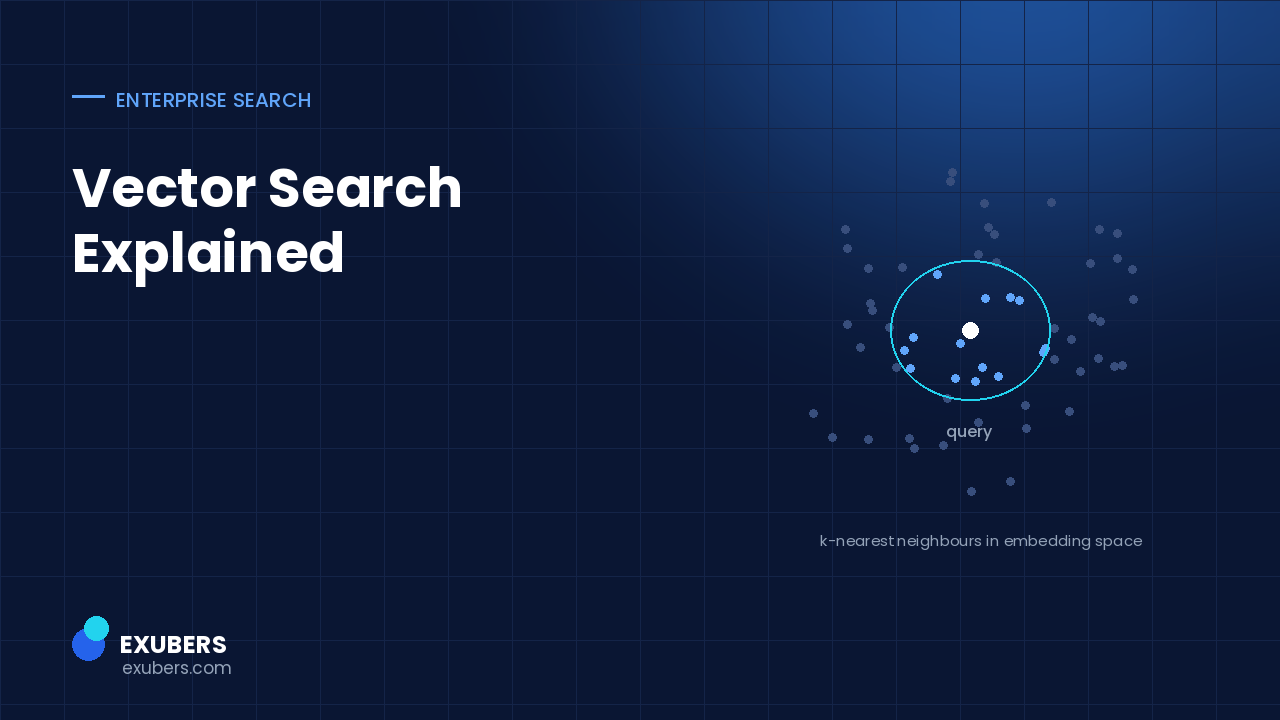
Instead of comparing words, Vector Search compares distances between vectors.
Documents whose vectors are closest to the query are considered the most relevant.
This allows AI to retrieve documents with similar meaning even when they use different terminology.
The most relevant documents are returned to the AI system.
If Retrieval-Augmented Generation (RAG) is being used, these documents are then passed to the Large Language Model to generate an accurate answer grounded in enterprise data.
Embeddings are one of the most important concepts behind Vector Search.
An embedding is a numerical representation of text that captures its meaning.
Instead of treating words independently, embeddings understand relationships.
For example:
The words:
are represented closely because they have similar meanings.
Likewise:
are positioned near each other in vector space.
This enables AI to retrieve information based on concepts rather than exact wording.
Understanding the difference between these approaches helps explain why AI-powered search delivers better results.
| Feature | Keyword Search | Vector Search |
|---|---|---|
| Exact Keyword Matching | Yes | No |
| Understands Meaning | No | Yes |
| Handles Synonyms | Limited | Excellent |
| Natural Language Support | Basic | Advanced |
| Context Awareness | No | Yes |
| AI Ready | Limited | Yes |
| Semantic Similarity | No | Yes |
| Enterprise AI Compatible | Limited | Excellent |
Traditional search focuses on matching words.
Vector Search focuses on matching meaning.
This difference dramatically improves enterprise search accuracy.
Modern Enterprise AI platforms process huge volumes of organizational knowledge every day.
Employees ask questions like:
These questions rarely match document titles exactly.
Vector Search enables AI to understand what employees actually want and retrieve the most relevant information from connected enterprise systems.
Without Vector Search, Enterprise AI would behave much like an old keyword search engine.
With Vector Search, AI becomes conversational, intelligent, and context-aware.
Organizations adopting Vector Search experience several advantages:
These benefits make Vector Search a foundational technology for modern AI applications.
Enterprise Search has evolved significantly over the last decade.
Earlier enterprise search solutions relied mainly on keyword indexing. While useful, they often failed to retrieve the right information when employees used different terminology than the document author.
Vector Search changes this completely.
Instead of looking for identical words, it understands the intent behind a user’s query and finds documents with the closest meaning.
This enables employees to search naturally without needing to know exact document names or keywords.
For example, an employee asks:
“Show me our latest cybersecurity policy.”
Even if the document is titled:
Vector Search recognizes the similarity and retrieves the correct information.
This significantly improves the employee search experience.
Modern Enterprise AI systems process information from multiple business applications.
These include:
Employees expect AI to search across all these systems through a single conversational interface.
Without Vector Search, AI would struggle to identify relationships between documents stored across different applications.
Vector Search creates a unified understanding of enterprise knowledge, allowing AI to retrieve relevant information regardless of where it is stored.
Retrieval-Augmented Generation (RAG) has become the preferred architecture for Enterprise AI because it combines intelligent retrieval with generative AI.
Vector Search is one of the most important components of this architecture.
A typical workflow looks like this:
An employee asks a question.
Example:
“What is our expense reimbursement policy?”
The query is converted into a vector (embedding).
Vector Search identifies the most relevant enterprise documents based on semantic similarity.
RAG retrieves those verified documents from connected business systems.
A Large Language Model generates an answer using the retrieved information rather than relying solely on pre-trained knowledge.
The employee receives an accurate, context-aware, and permission-aware response.
This process helps reduce hallucinations while improving the quality of AI-generated answers.
Vector Search is already helping organizations solve practical business challenges.
HR teams manage thousands of documents, including:
Employees can ask questions conversationally instead of searching through folders.
IT departments use Vector Search to retrieve:
Support engineers spend less time searching and more time resolving issues.
Sales representatives frequently need:
Vector Search enables faster access to these resources, improving sales productivity and response times.
Support teams benefit by quickly locating:
This leads to faster issue resolution and improved customer satisfaction.
Legal professionals use Vector Search to locate:
Finding relevant legal information becomes much faster and more accurate.
Finance teams can retrieve:
This reduces manual search effort and improves operational efficiency.
Vector Search is becoming an essential technology across multiple industries.
Hospitals and healthcare providers use Vector Search to access clinical guidelines, treatment protocols, operational policies, and medical documentation quickly while maintaining strict access controls.
Financial institutions retrieve regulatory documentation, audit records, internal procedures, and customer information more efficiently.
Manufacturers locate production manuals, maintenance procedures, quality standards, and safety documentation through AI-powered search.
Retail organizations improve access to supplier documentation, inventory information, employee training materials, and customer support knowledge.
Educational institutions organize research papers, course materials, institutional policies, and administrative documents using Semantic and Vector Search technologies.
Government agencies use Vector Search to improve access to regulations, internal policies, citizen service documentation, and operational procedures while maintaining governance and compliance.
Traditional relational databases were never designed for AI similarity search.
This is why specialized vector databases have become increasingly important.
A vector database is optimized to:
These capabilities make vector databases a core component of modern Enterprise AI architectures.
Organizations implementing Vector Search often experience measurable business improvements.
Employees find relevant information even when different terminology is used.
Less time spent searching means more time spent on meaningful work.
Managers gain quicker access to trusted information, enabling faster business decisions.
Employees discover related documentation automatically, improving collaboration and learning.
Vector Search connects multiple enterprise systems into one intelligent search experience.
Enterprise AI assistants, chatbots, and RAG systems become significantly more accurate when powered by Vector Search.
Intellowork uses Vector Search as one of the core technologies behind its Enterprise AI platform.
Instead of relying only on keyword matching, Intellowork converts enterprise knowledge into semantic embeddings, allowing employees to search using natural language and receive context-aware answers.
Combined with Semantic Search, Enterprise Search, and Retrieval-Augmented Generation (RAG), Vector Search helps Intellowork retrieve trusted business information from connected enterprise systems while respecting existing access permissions.
Whether employees need HR policies, sales documents, technical manuals, compliance documentation, or project information, Intellowork delivers accurate, AI-powered search experiences across the organization.
Implementing Vector Search successfully requires more than deploying a vector database. Organizations should build a strong foundation of high-quality enterprise data, secure access controls, and well-defined AI workflows.
Following these best practices helps maximize the value of Vector Search while improving search accuracy and employee adoption.
Vector Search performs best when enterprise knowledge is well organized.
Before implementing AI-powered search, organizations should:
High-quality data leads to higher-quality search results.
Employees rarely store information in one application.
To provide a complete search experience, organizations should connect platforms such as:
A unified knowledge layer enables employees to search all enterprise content through a single interface.
Not every employee should have access to every document.
A modern Enterprise AI platform should respect existing permissions so users only retrieve information they are authorized to view.
Role-based access control improves both security and compliance.
While Vector Search excels at understanding meaning, keyword search is still valuable for exact matches such as:
Many organizations adopt Hybrid Search, combining keyword search and Vector Search to achieve the highest search accuracy.
AI systems improve when organizations measure performance.
Track metrics such as:
These insights help refine both the AI model and the knowledge base over time.
Many Enterprise AI projects underperform because of preventable implementation mistakes.
Vector Search is an important component, but it is not a complete Enterprise AI platform.
Organizations also need:
These technologies work together to create an intelligent AI experience.
AI cannot generate reliable answers from outdated or inaccurate information.
Organizations should establish governance policies to maintain trusted enterprise knowledge.
Searching only one application limits AI effectiveness.
The greatest value comes from integrating multiple business systems into a unified enterprise knowledge platform.
Enterprise information often contains confidential business data.
Modern AI search platforms should include:
Security should be built into the platform from the beginning.
AI systems improve over time.
Organizations should continuously collect employee feedback, monitor search performance, and optimize their knowledge repositories.
Continuous improvement is essential for long-term success.
Vector Search is rapidly becoming the standard technology behind modern Enterprise AI.
As AI models continue to evolve, Vector Search will play an even greater role in helping organizations retrieve, understand, and use enterprise knowledge.
Future developments are expected to include:
These advancements will transform enterprise search from a document retrieval tool into an intelligent decision-support system.
Organizations create and store more digital information every year.
Without intelligent retrieval, employees waste valuable time searching instead of working.
Vector Search enables businesses to:
For organizations investing in AI, Vector Search is no longer an optional enhancement—it is a foundational capability.
Intellowork combines Vector Search, Semantic Search, Enterprise Search, and Retrieval-Augmented Generation (RAG) to help organizations unlock the full value of their enterprise knowledge.
Instead of relying solely on keyword matching, Intellowork converts enterprise documents into semantic embeddings, enabling employees to ask questions in natural language and receive context-aware, permission-aware answers.
By integrating with platforms such as Google Workspace, Microsoft 365, SharePoint, Slack, Microsoft Teams, CRM systems, HRMS software, and internal databases, Intellowork creates a unified search experience that improves productivity and reduces the time employees spend searching for information.
This architecture allows organizations to build secure Enterprise AI solutions that scale with business growth while maintaining data security and governance.
Vector Search is an AI-powered search method that retrieves information based on semantic similarity rather than exact keyword matching. It helps AI understand the meaning behind user queries.
Keyword search looks for exact words within documents, while Vector Search compares mathematical representations (embeddings) to identify documents with similar meaning, even if they use different wording.
Embeddings are numerical representations of text, images, or other data. They capture semantic relationships, enabling AI systems to compare meaning instead of just matching keywords.
Vector Search allows Enterprise AI platforms to retrieve relevant information from large knowledge repositories, improving search accuracy, enabling natural language queries, and supporting Retrieval-Augmented Generation (RAG).
Yes. Modern Enterprise AI platforms can integrate Vector Search with systems such as Google Workspace, Microsoft 365, SharePoint, Slack, CRM software, HRMS platforms, internal databases, and many other enterprise applications.
Yes. Enterprise implementations typically include role-based access controls, encryption, Single Sign-On (SSO), audit logs, and permission-aware retrieval to ensure users only access authorized information.
Yes. Intellowork uses Vector Search alongside Semantic Search and RAG to deliver fast, accurate, and secure enterprise search experiences powered by organizational knowledge.
Traditional keyword search has reached its limits in today’s data-rich business environment.
Employees need search systems that understand context, recognize intent, and retrieve information based on meaning rather than exact wording.
Vector Search delivers this capability by transforming enterprise knowledge into semantic representations that AI can understand and compare efficiently.
When combined with Semantic Search, Retrieval-Augmented Generation (RAG), and Large Language Models, Vector Search becomes the foundation of modern Enterprise AI.
Organizations that invest in this technology can improve productivity, accelerate decision-making, eliminate knowledge silos, and provide employees with instant access to trusted business information.
As enterprise data continues to grow, Vector Search will play an increasingly important role in building intelligent, scalable, and secure AI-powered workplaces.
Your organization’s knowledge is valuable only when employees can access it quickly and securely.
With Intellowork, you can leverage Vector Search, Semantic Search, Enterprise Search, and Retrieval-Augmented Generation (RAG) to create an AI-powered search experience that understands user intent, retrieves trusted information, and improves productivity across your organization.
Book a personalized demo today and discover how Intellowork can help you transform enterprise knowledge into a strategic business advantage.

Yatin Chaudhary writes on enterprise search, AI retrieval and platform engineering at Exubers Technologies, where the team builds search, AI, cloud and DevOps systems for enterprises across India and the GCC.
RAG accuracy is two scores, not one. See how to build a gold question set, measure both halves, and set release gates that hold.
A multilingual AI chatbot answers a Hindi question from English documents. Here is the architecture, the testing method and a…
A repeatable way to test an AI chatbot before launch: build a golden question set, score retrieval and grounding separately, and…
Tell us what you are trying to ship. We will tell you what it actually takes — scope, sequence and the risks worth knowing about before you commit budget.