AI Chatbots
How to Measure RAG Accuracy Before You Launch
RAG accuracy is two scores, not one. See how to build a gold question set, measure both halves, and set release gates that hold.
Imagine a sales executive searching for the latest pricing document before an important client meeting. The file exists—but it's stored in someone else's folder. Meanwhile, the customer…
 By Yatin Chaudhary
6 min read
Updated 1 Sep 2026
By Yatin Chaudhary
6 min read
Updated 1 Sep 2026
Imagine a sales executive searching for the latest pricing document before an important client meeting. The file exists—but it’s stored in someone else’s folder. Meanwhile, the customer waits, the meeting gets delayed, and an opportunity is lost.
Now imagine the same problem happening across HR, IT, Operations, Customer Support, Finance, and Marketing every single day.
This is the hidden cost of knowledge silos.
Information exists within the organization, but employees cannot easily find, access, or use it.
As businesses generate more digital content than ever before, knowledge silos have become one of the biggest barriers to productivity and collaboration.
Fortunately, Artificial Intelligence is changing how organizations manage and access information.
In this guide, we’ll explore what knowledge silos are, why they hurt businesses, and how AI-powered enterprise search helps organizations unlock their collective knowledge.
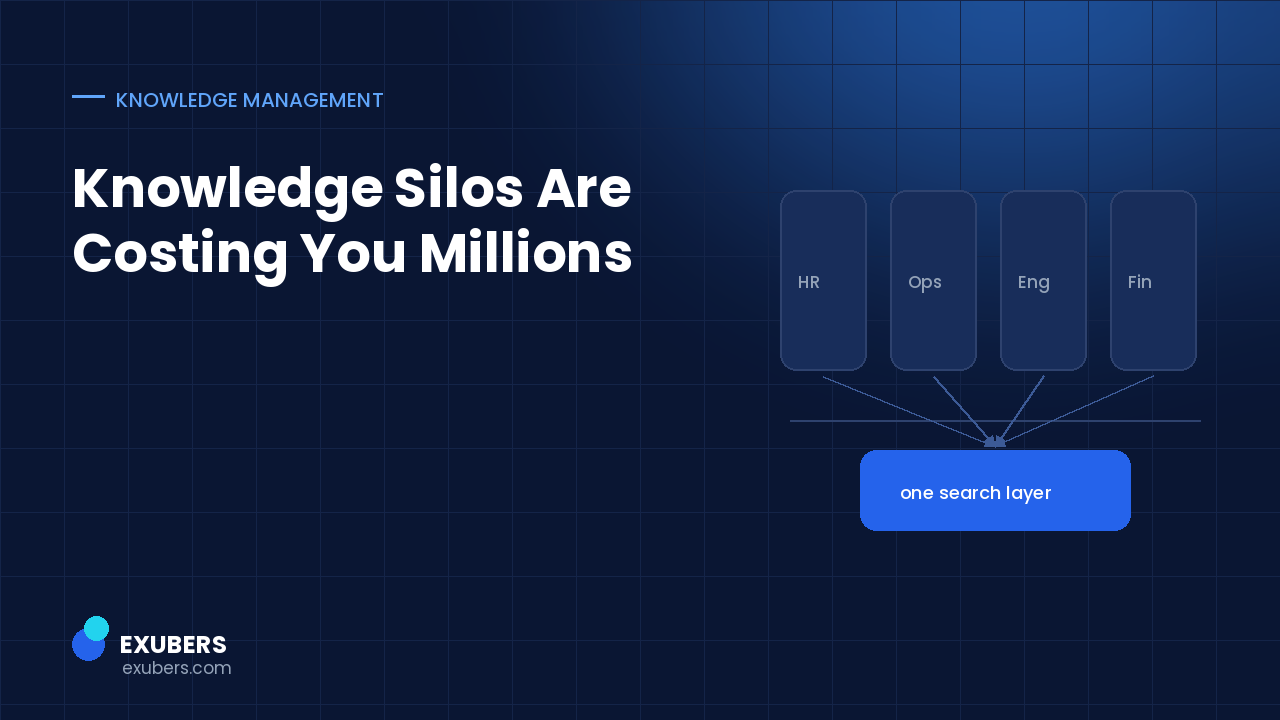
Knowledge silos occur when valuable business information is isolated within departments, systems, or individuals instead of being easily accessible across the organization.
Information may exist in:
Although these platforms contain important information, employees often struggle to locate the exact answers they need.
Instead of enabling collaboration, disconnected systems create barriers that slow down work.
Knowledge silos don’t appear overnight. They develop as organizations grow and adopt new tools.
Some common causes include:
Different departments often use different software platforms, making information difficult to locate.
Without a unified knowledge system, documents become scattered across multiple repositories.
Employees frequently save documents locally or share information through email instead of centralized systems.
When experienced employees leave the organization, valuable institutional knowledge often leaves with them.
Traditional search systems rely on keywords and document names rather than understanding context.
Many organizations underestimate how expensive poor knowledge management can be.
Employees spend valuable time searching for information instead of completing meaningful work.
Across hundreds or thousands of employees, those lost minutes quickly become significant business costs.
Leaders cannot make fast decisions when accurate information is difficult to access.
Delays affect customers, projects, and business growth.
Teams often recreate documents or repeat research simply because existing knowledge cannot be found.
This wastes both time and resources.
Customer-facing teams cannot deliver quick responses when information is scattered across multiple systems.
New employees spend weeks searching for policies, documentation, and training materials instead of becoming productive.
Your business may be experiencing knowledge silos if employees frequently:
If these situations sound familiar, your organization likely has a knowledge accessibility problem—not a knowledge shortage.
Artificial Intelligence changes the way employees interact with organizational knowledge.
Instead of searching through folders, applications, and documents, employees simply ask questions in natural language.
AI retrieves relevant information instantly.
Modern AI platforms connect information across:
Employees no longer need to remember where information is stored.
Unlike traditional search systems, AI understands context.
Employees can ask:
Instead of returning hundreds of documents, AI delivers the most relevant answer.
Modern enterprise AI uses Retrieval-Augmented Generation (RAG) to search trusted business systems before generating responses.
This helps:
Enterprise AI platforms respect existing user permissions.
Employees only receive information they are authorized to access.
This protects sensitive business information while improving accessibility.
Organizations implementing AI-powered enterprise search experience several benefits.
Employees spend less time searching and more time creating value.
Departments can easily share information without switching between multiple applications.
Access to current business knowledge enables faster and more informed decisions.
Support teams can retrieve accurate information instantly, reducing response times.
New employees gain immediate access to organizational knowledge without relying heavily on senior team members.
Eliminating duplicate work and improving information accessibility helps reduce operational inefficiencies.
Traditional keyword-based search systems are no longer enough.
Modern businesses require intelligent systems capable of understanding natural language, connecting multiple data sources, and delivering accurate answers instantly.
Enterprise search powered by AI transforms organizational knowledge into a strategic business asset.
Instead of asking “Where is this document?”, employees simply ask “What do I need to know?”
That shift dramatically improves productivity across every department.
Intellowork is designed to eliminate knowledge silos by connecting all your enterprise information into one intelligent AI-powered search experience.
Whether your business stores information in Google Drive, Microsoft SharePoint, Slack, Microsoft Teams, Confluence, CRM systems, HRMS platforms, or internal databases, Intellowork securely brings that knowledge together.
Using AI-powered enterprise search, Retrieval-Augmented Generation (RAG), and role-based access controls, employees can ask questions in natural language and receive accurate, permission-aware answers in seconds.
With Intellowork, organizations can:
Instead of knowledge being locked inside departments or applications, Intellowork transforms your organization’s information into an accessible, searchable, and intelligent knowledge ecosystem.
Businesses don’t suffer because they lack information—they suffer because employees can’t access the information that already exists.
As organizations continue to generate more data, breaking down knowledge silos will become essential for staying competitive.
AI-powered enterprise search is no longer just a productivity tool. It is becoming the foundation of modern knowledge management.
Organizations that invest in intelligent knowledge access today will be better prepared for the future of work.
Knowledge silos occur when valuable business information is stored in isolated systems, departments, or individuals, making it difficult for others to access and use.
They reduce productivity, slow decision-making, create duplicate work, increase onboarding time, and negatively impact collaboration and customer service.
AI connects multiple enterprise systems, understands natural language queries, retrieves relevant information, and provides accurate answers without requiring employees to search manually.
Enterprise search is an AI-powered solution that enables employees to search across multiple business systems from a single interface and receive contextual, permission-aware answers.
Intellowork securely connects enterprise data sources, uses AI-powered enterprise search and RAG technology to deliver instant answers, and helps organizations improve productivity while maintaining enterprise-grade security.

Yatin Chaudhary writes on enterprise search, AI retrieval and platform engineering at Exubers Technologies, where the team builds search, AI, cloud and DevOps systems for enterprises across India and the GCC.
RAG accuracy is two scores, not one. See how to build a gold question set, measure both halves, and set release gates that hold.
A multilingual AI chatbot answers a Hindi question from English documents. Here is the architecture, the testing method and a…
A voice AI agent answers support calls from your own documents. See the stack, the latency budget and a safe rollout plan.
Tell us what you are trying to ship. We will tell you what it actually takes — scope, sequence and the risks worth knowing about before you commit budget.