AI & Automation
Voice AI Agent for Customer Support: A Practical Build Guide
A voice AI agent answers support calls from your own documents. See the stack, the latency budget and a safe rollout plan.
Artificial Intelligence has evolved rapidly over the past few years. Businesses initially adopted AI to generate content, answer customer queries, and automate simple repetitive tasks…
 By Yatin Chaudhary
9 min read
Updated 1 Sep 2026
By Yatin Chaudhary
9 min read
Updated 1 Sep 2026
Artificial Intelligence has evolved rapidly over the past few years. Businesses initially adopted AI to generate content, answer customer queries, and automate simple repetitive tasks. Today, however, AI is entering a completely new phase—AI Agents.
Unlike traditional AI chatbots that respond only when prompted, AI agents can understand goals, plan actions, retrieve information, make decisions within defined boundaries, and execute tasks across multiple business systems.
For enterprises, this marks a significant shift. Instead of using AI as a simple assistant, organizations can deploy AI agents that actively support employees, streamline workflows, and improve operational efficiency.
From customer support and HR to IT operations, finance, and sales, AI agents are becoming an essential part of the modern digital workplace.
In this guide, you’ll learn what AI agents are, how they work, why enterprises are investing in them, and how they are shaping the future of intelligent business operations.
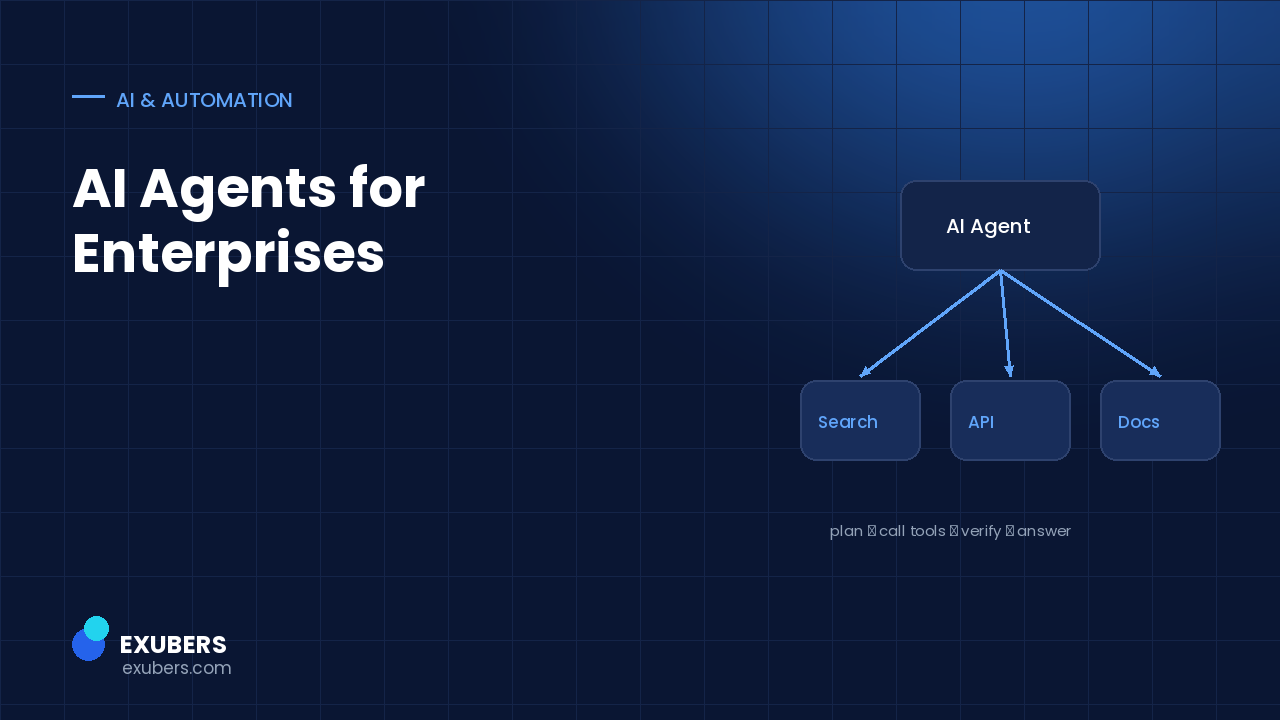
An AI agent is an intelligent software system that can perceive information, reason about a task, decide on the next action, and execute that action to achieve a specific objective.
Unlike a standard chatbot that simply answers questions, an AI agent can perform multi-step tasks by interacting with different tools, applications, and business systems.
For example, imagine an employee asking:
“Prepare a summary of last month’s sales performance and email it to the regional managers.”
A traditional chatbot may provide guidance on where to find the report.
An AI agent can:
This ability to plan, retrieve, and act is what makes AI agents fundamentally different from conventional AI assistants.
Many organizations assume AI agents and chatbots are the same. While both use artificial intelligence, their capabilities differ significantly.
| Feature | Traditional AI Chatbot | AI Agent |
|---|---|---|
| Answers Questions | ✅ | ✅ |
| Understands Context | Limited | Advanced |
| Multi-Step Task Execution | ❌ | ✅ |
| Uses Business Tools | Limited | ✅ |
| Decision Support | Basic | Advanced |
| Workflow Automation | ❌ | ✅ |
| Learns From Context | Limited | Yes (within configured systems) |
| Enterprise Integrations | Basic | Extensive |
A chatbot primarily provides information.
An AI agent helps complete work.
Businesses generate massive volumes of information every day. Employees often spend valuable time switching between applications, searching for documents, updating records, and completing repetitive administrative work.
AI agents help eliminate these inefficiencies.
Instead of requiring employees to manually coordinate between different systems, AI agents automate much of the process while keeping humans in control of important decisions.
As organizations continue their digital transformation journey, AI agents are becoming valuable partners rather than simple software tools.
AI agents can search across enterprise systems such as:
Instead of opening multiple applications, employees simply ask a question and receive relevant information immediately.
Modern AI agents understand conversational language.
Employees do not need to memorize file names, keywords, or system locations.
For example:
The AI understands the request and retrieves the most relevant information.
One of the biggest advantages of AI agents is their ability to automate routine workflows.
Examples include:
This reduces manual effort and allows employees to focus on higher-value work.
Enterprise AI agents analyze available business information before generating recommendations.
For example, a sales manager might ask:
“Which deals require immediate attention this week?”
Instead of displaying raw CRM data, the AI agent can analyze opportunities, identify risks, and provide prioritized recommendations based on available information.
This enables faster and more informed decision-making.
Although AI agents appear conversational on the surface, they rely on several advanced technologies working together.
The AI interprets the employee’s request using natural language processing (NLP).
It determines the intent behind the question instead of relying solely on keyword matching.
Using Retrieval-Augmented Generation (RAG), the AI searches connected business systems for relevant information.
Rather than relying only on its training data, it retrieves current and trusted business knowledge.
The AI determines the sequence of steps needed to complete the task.
For example:
This planning capability distinguishes AI agents from traditional chatbots.
After receiving the necessary permissions, the AI agent performs the requested actions using connected enterprise applications.
Examples include updating CRM records, retrieving documents, creating tickets, or generating reports.
Enterprise AI agents continuously improve through user feedback, workflow optimization, and updated business knowledge.
However, they remain governed by organizational policies, access controls, and security rules to ensure safe and compliant operation.
Traditional AI systems focused primarily on answering questions.
Modern enterprises require AI that can understand, reason, retrieve information, and take meaningful actions across business applications.
AI agents bridge this gap by combining conversational intelligence with workflow automation, enterprise search, and contextual decision support.
Instead of simply helping employees find information, AI agents help them complete work faster, more accurately, and with fewer manual steps.
As organizations adopt digital transformation initiatives, they often discover that simply having access to information is not enough. Employees also need intelligent systems that can help them complete tasks faster and with greater accuracy.
AI agents deliver measurable business value across departments by combining automation, enterprise search, and intelligent decision support.
One of the biggest advantages of AI agents is the amount of time they save.
Employees frequently spend hours every week:
AI agents automate these repetitive activities, allowing employees to focus on strategic work that requires creativity and human judgment.
Instead of switching between ten different applications, employees can complete multiple tasks from a single AI interface.
Large organizations often store information across multiple platforms.
Some departments use SharePoint.
Others rely on Google Drive.
Customer support teams work inside ticketing systems.
HR manages policies in separate platforms.
Sales teams depend on CRM software.
This fragmented environment creates knowledge silos.
AI agents connect these systems and make enterprise knowledge accessible through a single conversational interface.
Employees no longer need to know where information is stored—they simply ask for it.
Business leaders make better decisions when they have access to accurate and current information.
AI agents can gather information from multiple enterprise systems, summarize findings, identify trends, and present actionable insights.
Instead of manually reviewing dozens of reports, managers receive concise recommendations supported by organizational data.
This improves both the speed and quality of business decisions.
Routine administrative work consumes valuable employee time.
Examples include:
AI agents automate many of these repetitive activities, reducing operational costs while increasing overall efficiency.
Departments often work with different tools and processes.
AI agents help bridge communication gaps by making information easily accessible regardless of where it is stored.
Marketing can quickly access sales documentation.
HR can retrieve IT policies.
Finance can locate procurement records.
Operations teams can access project documentation instantly.
This creates a more connected organization.
These two terms are often used interchangeably, but they are not exactly the same.
| Feature | AI Assistant | AI Agent |
|---|---|---|
| Answers Questions | ✅ | ✅ |
| Searches Enterprise Data | ✅ | ✅ |
| Executes Multi-Step Tasks | Limited | ✅ |
| Automates Business Processes | Limited | ✅ |
| Uses Multiple Enterprise Systems | Sometimes | ✅ |
| Plans Actions Independently | No | Yes |
| Supports Complex Workflows | Limited | Advanced |
Think of it this way:
An AI assistant helps employees perform tasks.
An AI agent can help complete those tasks by coordinating actions across multiple business systems.
Many modern enterprise AI platforms combine both capabilities to create a seamless user experience.
HR departments receive hundreds of repetitive employee questions every month.
Examples include:
An AI agent can answer these questions instantly while retrieving information directly from official HR documentation.
It can also automate onboarding workflows, generate welcome documentation, and guide new employees through company processes.
IT support teams spend significant time resolving repetitive issues.
AI agents can:
This reduces support workload while improving response times.
Sales professionals need quick access to:
Instead of manually searching different systems, AI agents retrieve the required information within seconds.
Some enterprise AI agents can even prepare first drafts of proposals using existing company content.
Customer service representatives often switch between multiple systems during a single conversation.
AI agents simplify this process by retrieving:
This enables faster issue resolution and improves customer satisfaction.
Finance teams work with sensitive business information every day.
AI agents can assist by:
Because enterprise AI respects existing permissions, sensitive information remains secure.
Legal departments manage large volumes of contracts and compliance documents.
AI agents help lawyers and legal teams:
This significantly reduces manual document review time.
AI agents are no longer limited to technology companies.
Organizations across industries are adopting enterprise AI.
Hospitals use AI agents to retrieve medical procedures, administrative policies, and operational documentation while maintaining strict security controls.
Financial institutions deploy AI agents to improve compliance, customer service, document retrieval, and internal knowledge management.
Manufacturers use AI agents to access maintenance manuals, production procedures, quality documentation, and inventory information.
Retail organizations leverage AI agents for inventory management, customer support, supplier documentation, and employee assistance.
Universities use AI agents to help staff and students access policies, learning materials, administrative procedures, and institutional knowledge.
Government agencies increasingly adopt AI agents to improve document search, citizen services, and internal operational efficiency while maintaining strict security standards.
One of the biggest concerns organizations have is security.
Enterprise AI agents are designed differently from consumer AI tools.
Modern enterprise solutions include:
Users only access information they are authorized to view.
Integration with Single Sign-On (SSO) and identity providers ensures secure authentication.
Enterprise data remains protected through encryption during storage and transmission.
Organizations can monitor user activity, searches, and AI interactions for compliance and governance.
Many enterprise AI platforms support regulatory requirements across industries, helping organizations maintain data governance and compliance standards.
An AI agent is only as effective as the information it can access.
If enterprise knowledge remains fragmented across disconnected systems, even the most advanced AI model will struggle to deliver accurate answers.
This is why enterprise search plays a critical role.
By connecting documents, collaboration platforms, databases, and business applications into a unified knowledge layer, enterprise search provides AI agents with the context they need to retrieve reliable information.
Combined with Retrieval-Augmented Generation (RAG), enterprise search enables AI agents to deliver responses that are accurate, current, and grounded in trusted organizational data rather than relying solely on pre-trained knowledge.

Yatin Chaudhary writes on enterprise search, AI retrieval and platform engineering at Exubers Technologies, where the team builds search, AI, cloud and DevOps systems for enterprises across India and the GCC.
A voice AI agent answers support calls from your own documents. See the stack, the latency budget and a safe rollout plan.
What an HR policy chatbot should answer, what it must never touch, how to handle role and location variants, and the numbers that…
How to build an AI chatbot for Slack and Microsoft Teams that answers from your own documents, respects permissions, cites its…
Tell us what you are trying to ship. We will tell you what it actually takes — scope, sequence and the risks worth knowing about before you commit budget.